Q96 - Plant Species Richness Effects on Biomass and Soil Carbon/Nitrogen Stocks
Students cultured plants, including four grass species (A. capillaris, A. odoratum, F. rubra, and H. lanatus) and four herbs (C. jacea, L. vulgare, P. lanceolata, and R. acetosa) without legumes, in different blocks with treatments of monoculture and mixtures of two, four or all eight species. They then measured different parameters as functions of plant species richness, as shown in the figure below. Values are shown in log2 scale.
Figure Q.96, showing aboveground biomass, standing root biomass, soil C stocks, soil organic C decomposition rate, soil N stocks, and potential net N mineralization rate, each plotted against plant species richness (monoculture, 2, 4, or 8 species).
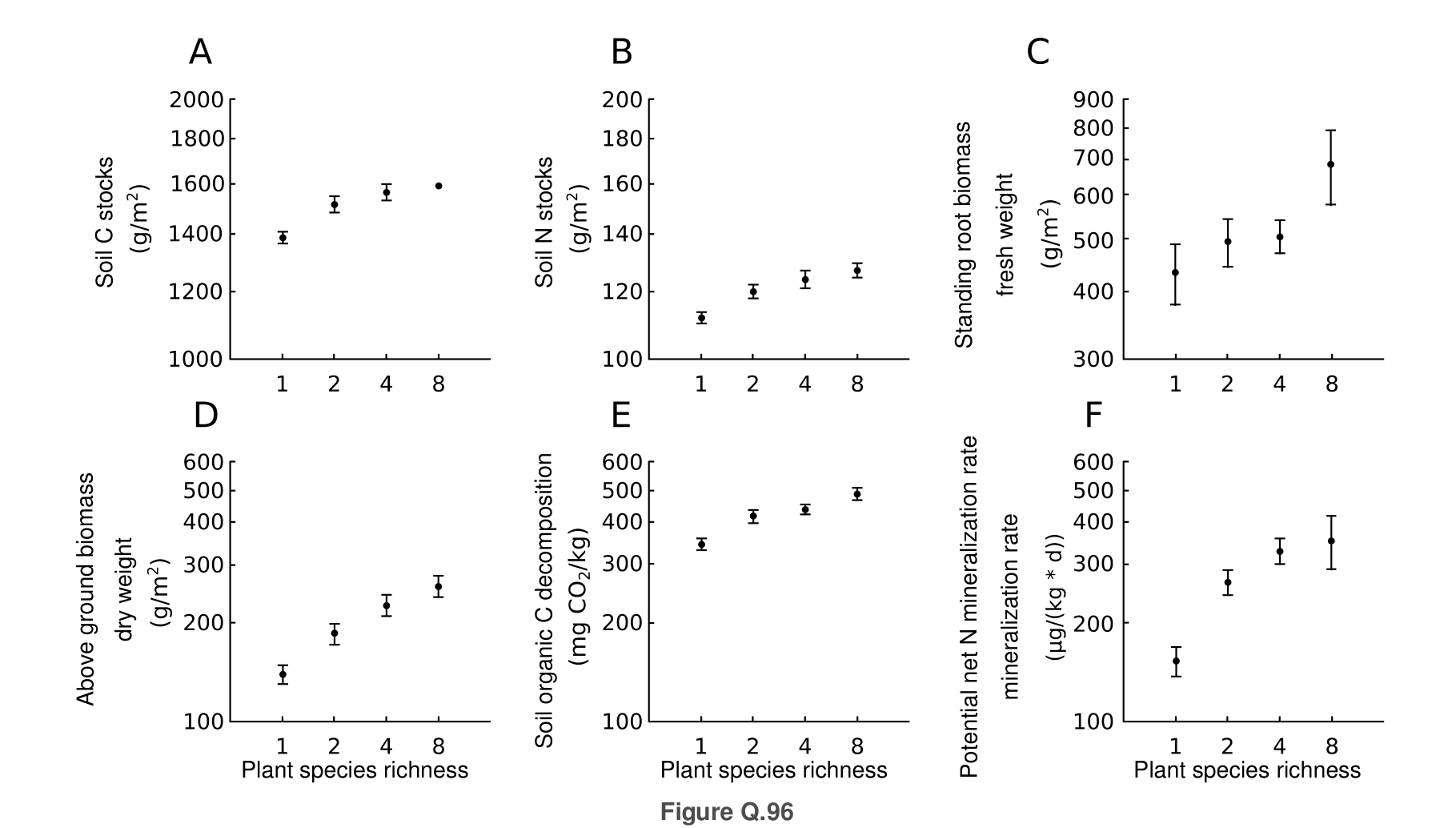 Figure 1.
Using the information and data, determine which of the statements are true or which are false.
Question reproduced from IBO 2016, Theoretical Paper B, licensed under CC BY-NC-SA 4.0 - attributed to the International Biology Olympiad. Open the full exam PDF · Community solutions (unofficial)