Q95 - Slug, Earthworm, and Vegetation-Type Effects on Forest Seedling Survival
To understand the effects of several factors on plants (Agrimonia rostellata and Trillium erectum) in forest ecosystems, students transplanted seedlings into experimental sites and observed the proportion of surviving seedlings growing with native or non-native vegetation, with or without slugs, and with low or high earthworm density. The results are shown in the figure below.
Figure Q.95 Proportion of surviving seedlings, for Agrimonia rostellata (panels A, B) and Trillium erectum (panels C, D), each shown with and without slugs present, crossed with native vs. non-native vegetation and low vs. high earthworm density.
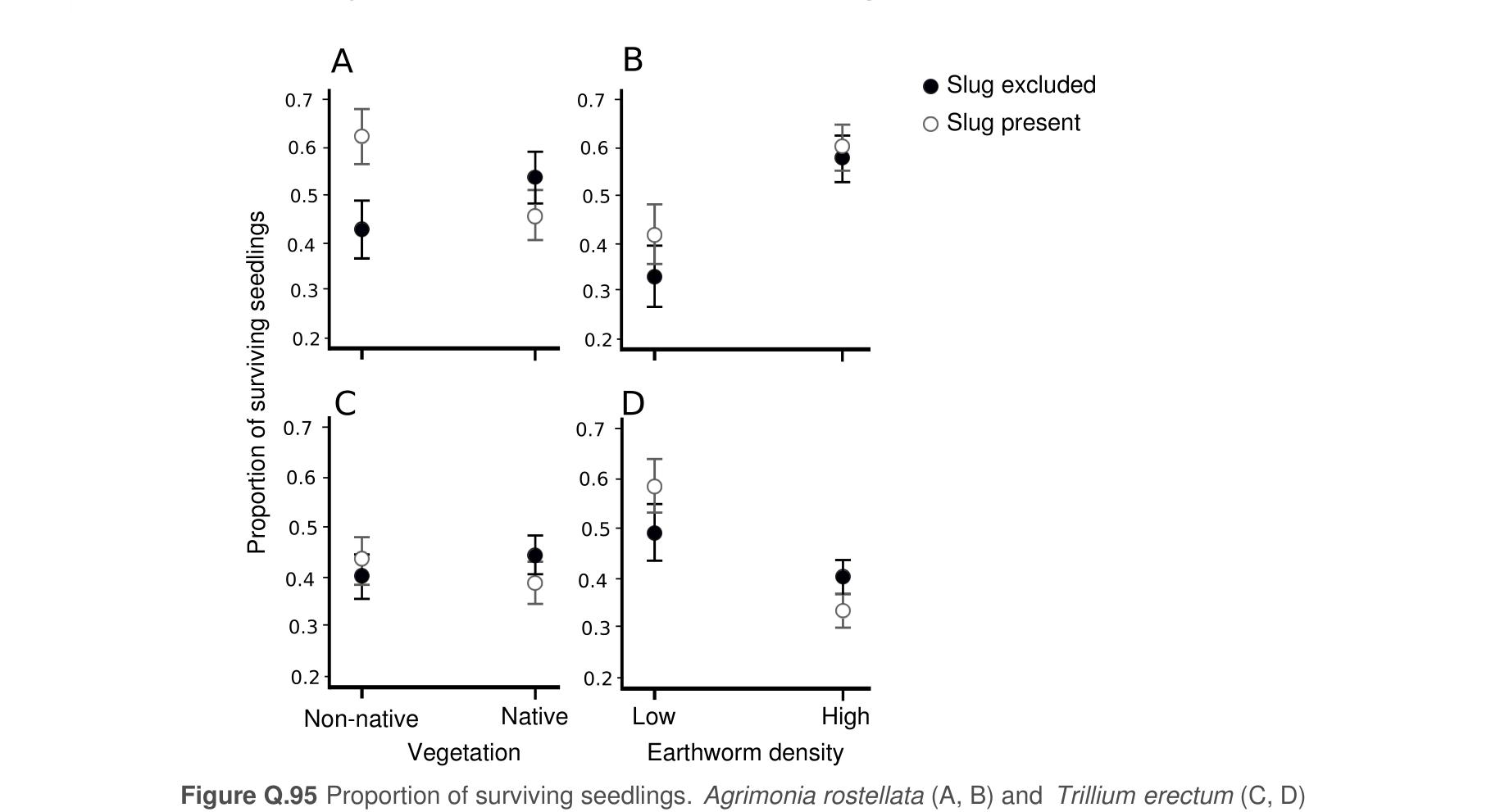 Figure 1.
Using the information and data, determine which of the statements are true or which are false.
Question reproduced from IBO 2016, Theoretical Paper B, licensed under CC BY-NC-SA 4.0 - attributed to the International Biology Olympiad. Open the full exam PDF · Community solutions (unofficial)