Q1 - Choosing a Sequencing Technology for Rare-Disease Genomes
Frederick Sanger (1918-2013) invented protein, RNA and DNA sequencing, and Sir Shankar Balasubramanian (1966-present) invented high-throughput DNA sequencing. The National Health Service is sequencing an unprecedented 100 000 genomes from rare-disease patients, but different sequencing technologies have different merits for this purpose, as described below.
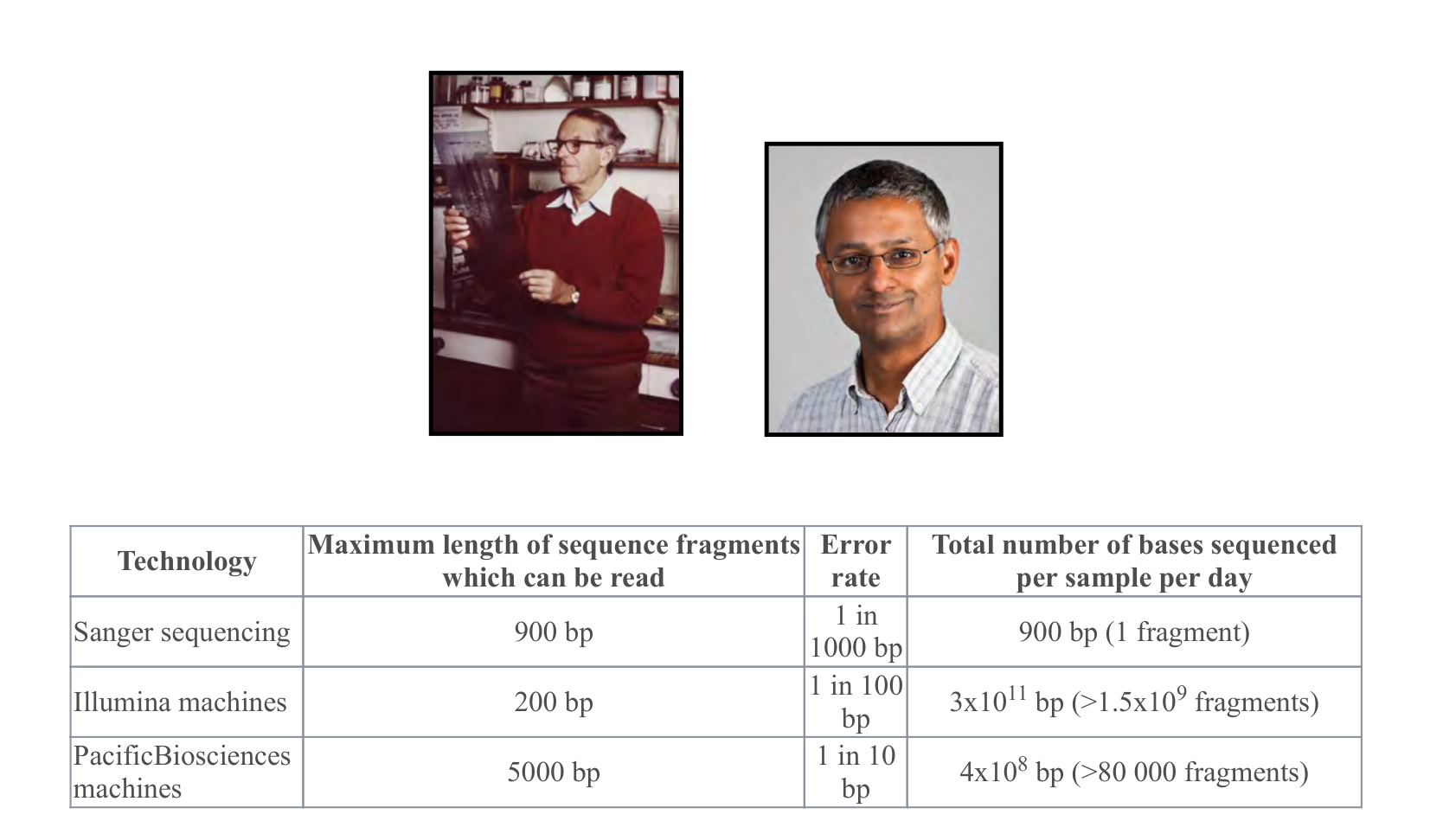
Using the information and data, determine which of the statements are true or which are false.
A. Illumina technology is best for finding new Single Nucleotide Variations (mutations to a single base) in the patient genomes.
B. PacificBiosciences technology is best for assessing transcriptional changes by RNA sequencing.
C. PacificBiosciences technology is best for finding rearrangements of chunks of DNA in the patient genomes.
D. Sanger sequencing is best for validating sequencing results before using patients’ genetic information to guide clinical interventions.
Question reproduced from IBO 2017, Theoretical Exam A, licensed under CC BY-NC-SA 4.0 - attributed to the International Biology Olympiad. Open the full exam PDF · Official answer key & worked solutions