Q11 - Recombination Mapping from a Three-Point Drosophila Cross
William Bateson (1861-1926) founded the discipline of modern genetics. Reginald Punnett (1875-1967) created a technique to predict the frequency of phenotypes with Mendelian inheritance, but Edith Saunders (1865- 1945) noticed some combinations of traits were not inherited in a Mendelian fashion. To investigate this phenomenon, the genetics of fly (Drosophila) traits can be analysed. A fictional Drosophila species was crossed according to the following sceme: WT flies have red-eyes (1) produced by mixing brown and cinnabar pigments. Mutating the white gene gives white eyes (2). Knocking out the cinnabar gene gives cinnabar eyes (3). Knocking out the brown gene gives brown eyes (4). WT flies have functional wings (5), whilst mutations in the vestigial gene lead to vestigial wings (6). White is carried on the X-chromosome. The genes brown-cinnabar-vestigial are carried on the same chromosome, in that order. Males with white-eyes and normal wings are crossed to females with white-eyes and vestigial wings. All offspring (F1) are red-eyed females, or white-eyed males. No F1 flies had vestigial wings. The F1 females are mated to a male that has white-eyes and vestigial wings. The female F2 flies from this cross are counted.
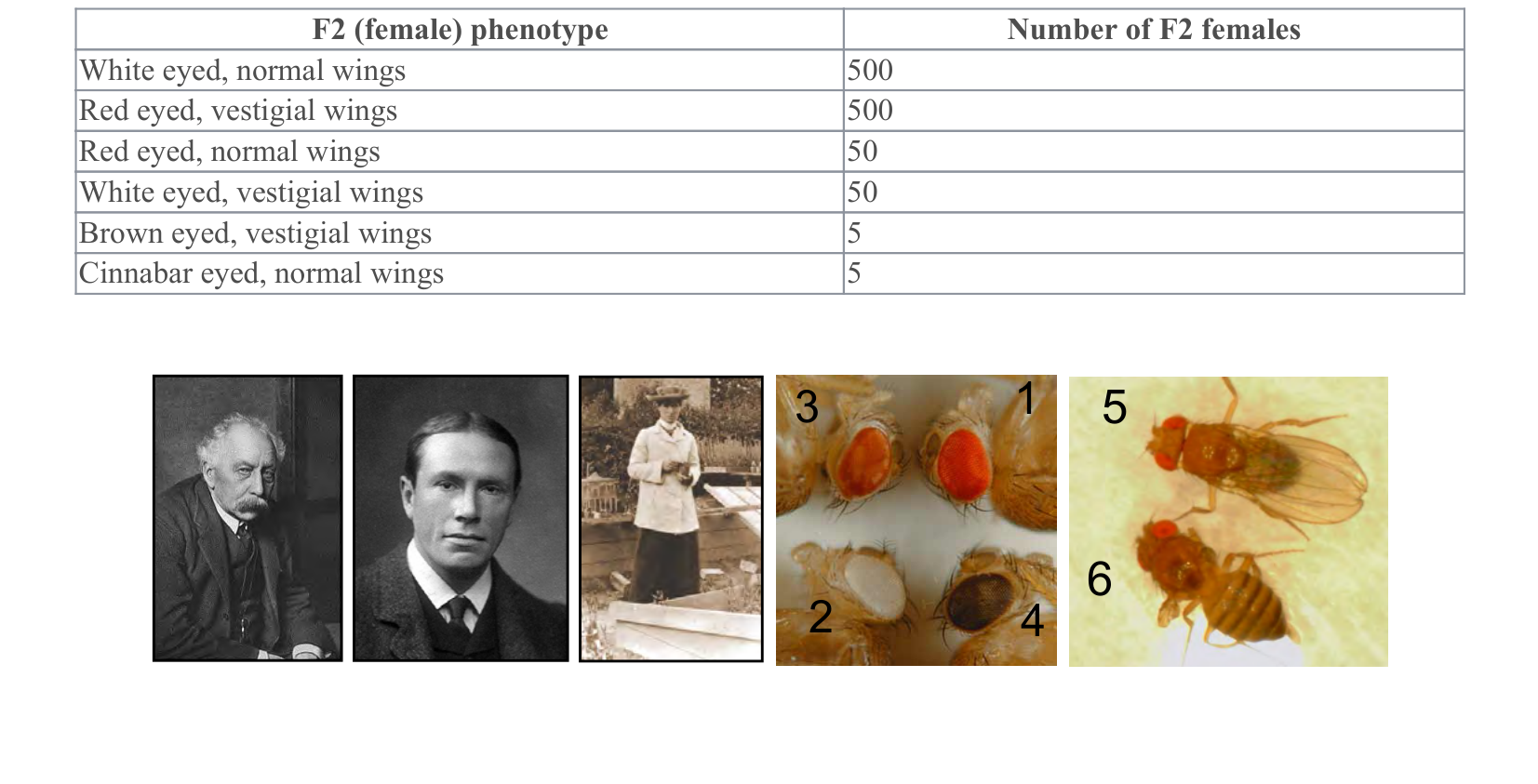
This question mixes multiple-choice/numeric-estimate parts with True/False statements - answer each part using the information and data above.
Question reproduced from IBO 2017, Theoretical Exam A, licensed under CC BY-NC-SA 4.0 - attributed to the International Biology Olympiad. Open the full exam PDF · Official answer key & worked solutions