Q24 - Directionality and Excitability of the Giant Worm Action Potential
Sir Alan Hodgkin (1914-1998) and Sir Andrew Huxley (1917-2012) explained how action potentials occur and spread. (i) Resting neurons have a negative voltage (membrane potential) across their membrane (more negative inside than outside). (ii) If the potential becomes less negative, ion channels open, making the voltage become positive. (iii) Channels shut in a time dependent fashion. (iv) Channels cannot re-open until the membrane returns to the resting negative voltage. (v) As one section of membrane becomes positive, electrical currents make adjacent sections less negative. Artificial action potentials can be triggered and measured in a giant neuron which runs the length of worms. A stimulating pair of electrodes are placed close to each other, against the worm, and a voltmeter placed further along is used to record the passing action potential. The trace from setup (1) is shown. Other setups (2, 3 & 4) were also tested.
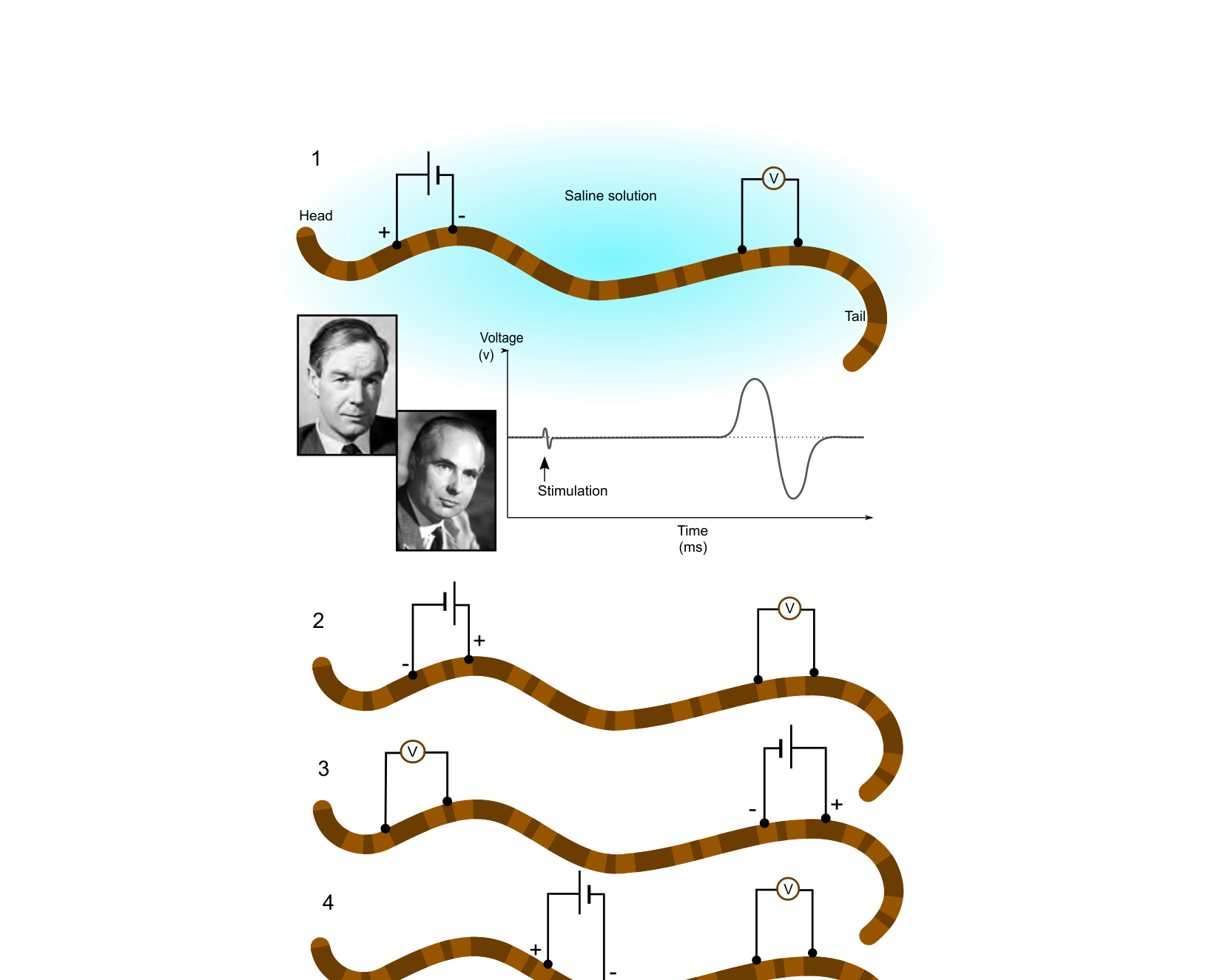
Using the information and data, determine which of the statements are true or which are false.
Question reproduced from IBO 2017, Theoretical Exam A, licensed under CC BY-NC-SA 4.0 - attributed to the International Biology Olympiad. Open the full exam PDF · Official answer key & worked solutions