Q23 - Geometry and Gradients Set Calcium Flow at the Muscle Membrane
Jean Hanson (1919-1973) discovered how muscles contract. Contraction is triggered by a build up of calcium in the cytoplasm, which is actively removed during relaxation. Calcium diffuses through plasma membrane channels (1), or endoplasmic reticulum membrane channels (2). (1, purple) Plasma membrane channels, opened by depolarisation, pore width = 1 atom (2, orange) ER channels, open by binding calcium on cytoplasmic face, pore width = 100s of atoms The concentrations of the major biological ions in different compartments are shown.
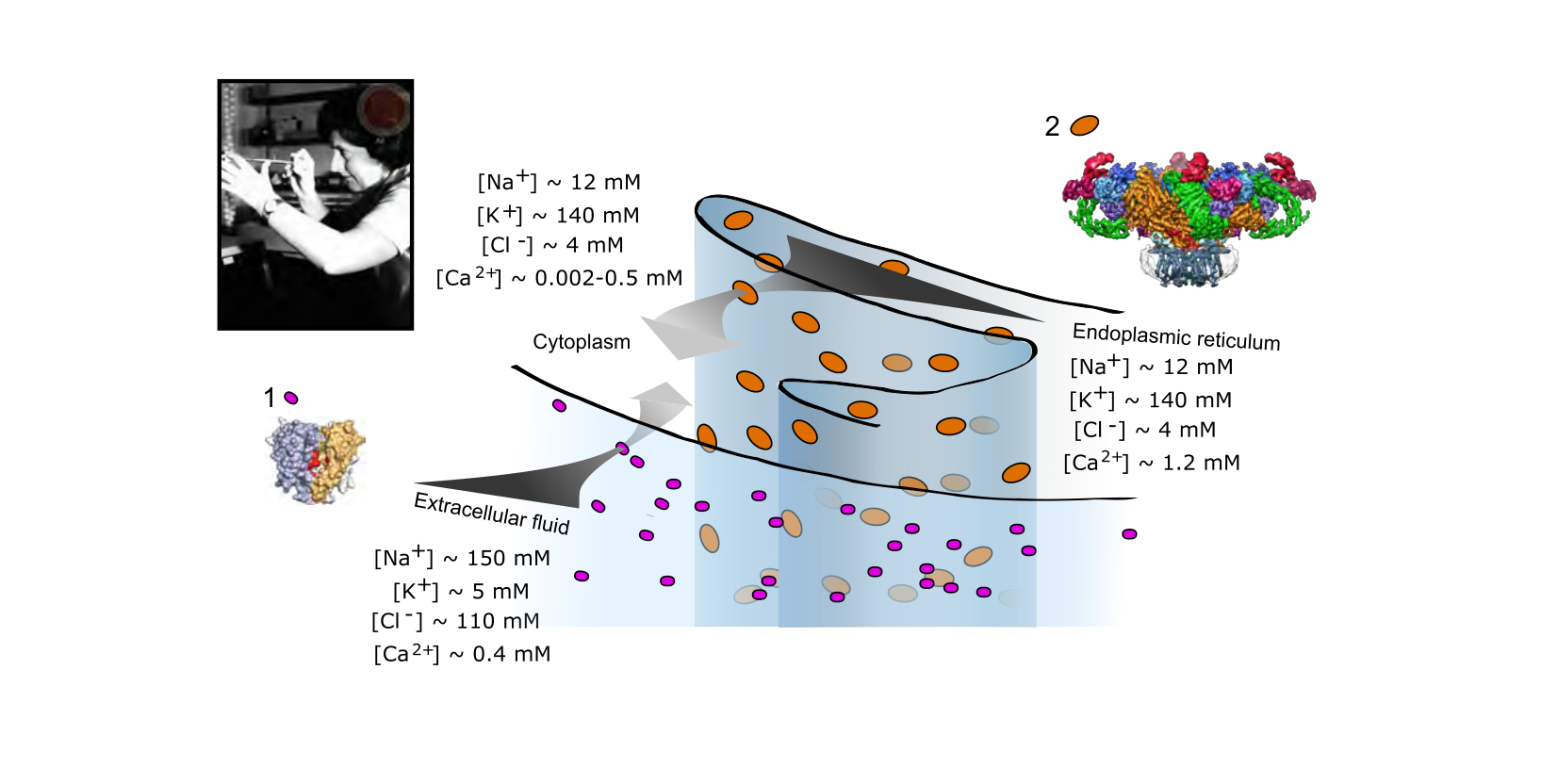
Using the information and data, determine which of the statements are true or which are false.
Question reproduced from IBO 2017, Theoretical Exam A, licensed under CC BY-NC-SA 4.0 - attributed to the International Biology Olympiad. Open the full exam PDF · Official answer key & worked solutions