Q28 - Optogenetically Implanting a False Fear Memory in Mice
Tim Bliss (1940-present) discovered that stimulating a neuron sensitises it to future stimulation, and that this is a basis of long term memory. This can occur because stimulation leads to transcription of ion channel genes. One of these channels was fused to a light sensitive protein, which allows it to be activated by fiber-optic implants, and cloned into mice. The mice were treated as follows: (1) Transcription of this channel was blocked in every cell, until adult mice were first shown a particular, non- threatening stimulus. (2) Transcription of this channel was re-blocked in every cell. (3) Mice were given an electric shock, causing them to freeze. In a subset of mice, electrocution was accompanied by a flash of fiber optic light to the brain. (4) Mice were shown the non-threatening stimulus again.
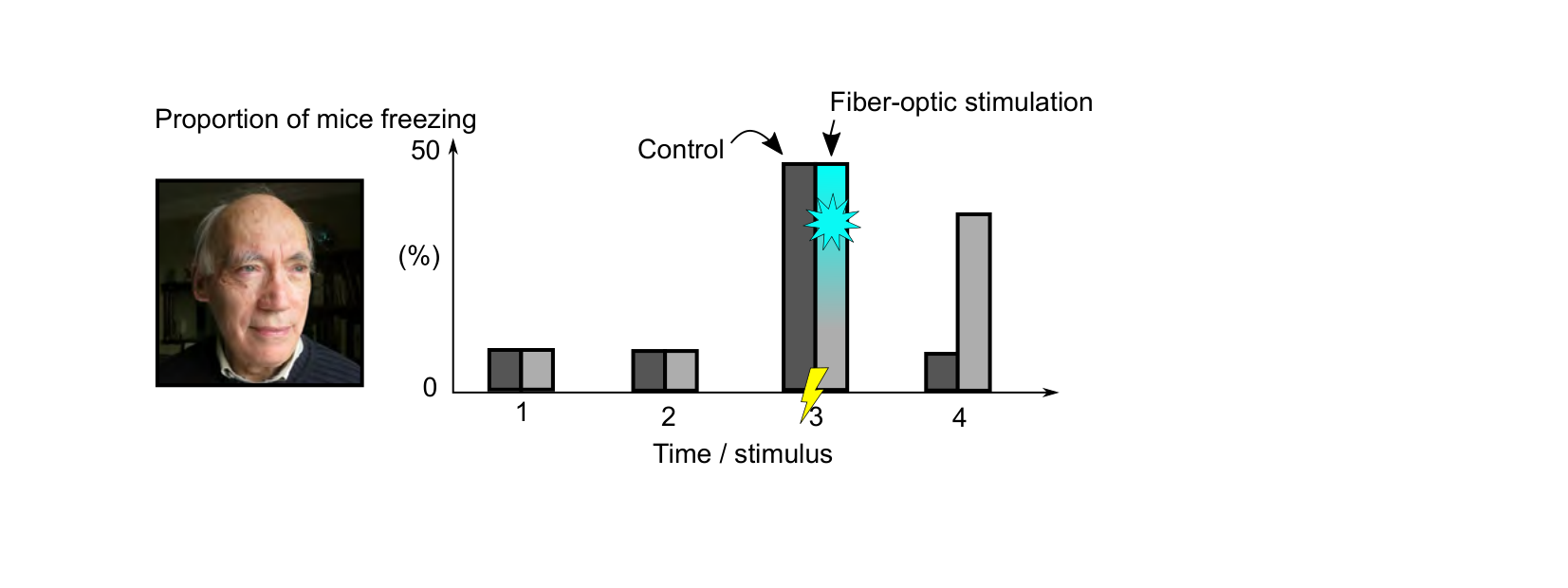
Using the information and data, determine which of the statements are true or which are false.
Question reproduced from IBO 2017, Theoretical Exam A, licensed under CC BY-NC-SA 4.0 - attributed to the International Biology Olympiad. Open the full exam PDF · Official answer key & worked solutions