Q11 - Diagnosing Heart Disease from Pressure-Volume Loops
The pressure and volume of beating ventricles can be measured as they change with time. Recordings (1) and (2) are from the same resting, healthy heart, beating at 60 beats per minute (bpm). At maximum cardiac output of 28.8 l/min, the maximum ventricular volume doubles, and the minimum ventricular volume halves. Recordings (3) and (4) are from different diseased hearts.
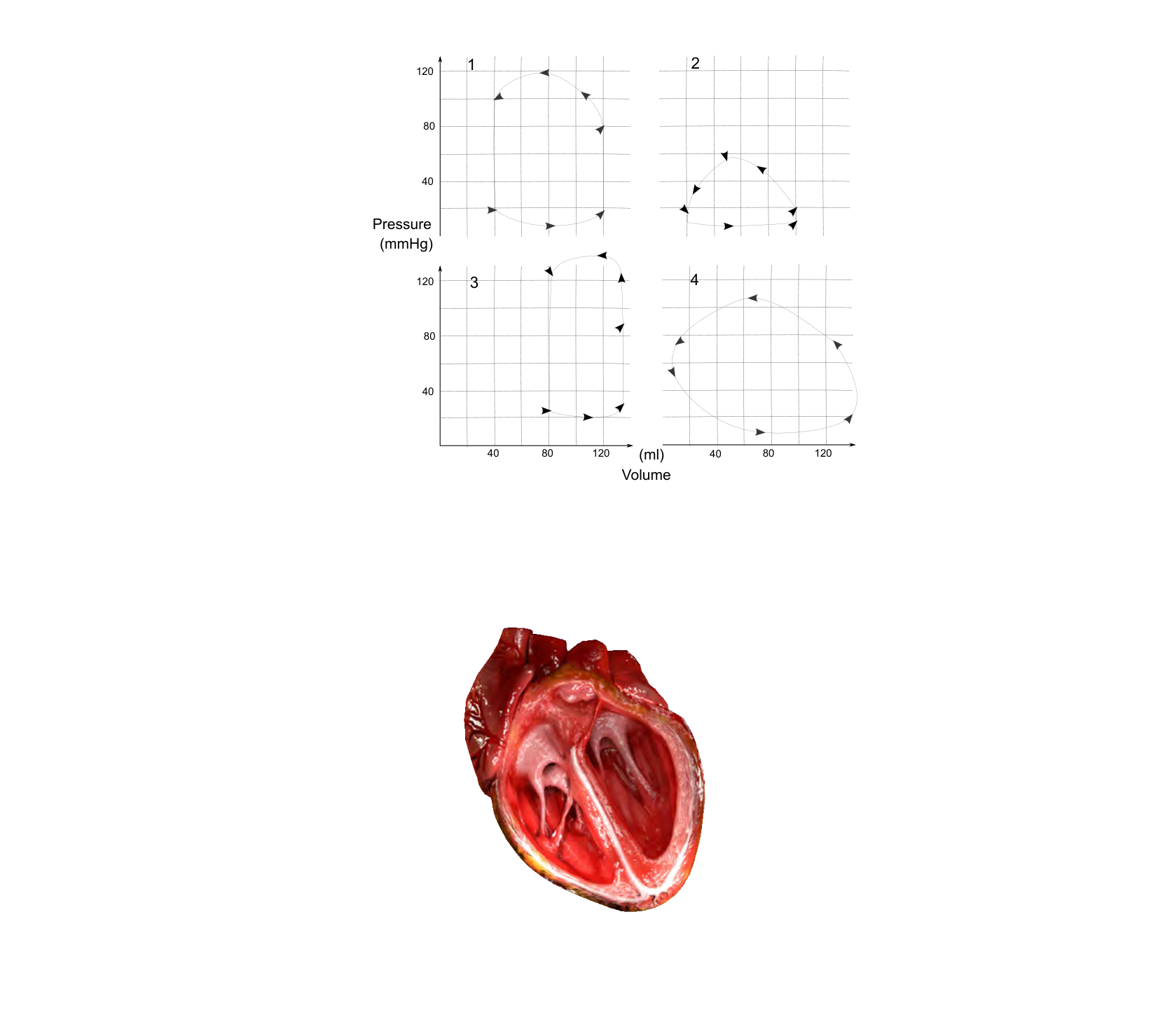
This question mixes multiple-choice/numeric-estimate parts with True/False statements - answer each part using the information and data above.
A. This healthy heart beats at 60 bpm with a pressure-volume loop spanning 40-120 ml. What is its cardiac output?
B. At maximum cardiac output (28.8 l/min), the maximum ventricular volume doubles to 240 ml and the minimum halves to 20 ml. What heart rate is needed to achieve this output?
C. Recording 1 is of the right-side of the heart, recording 2 is of the left-side of the heart.
D. Recording 3 indicates an aortic (arterial) obstruction.
E. Recording 4 indicates leaky heart valves.
Question reproduced from IBO 2017, Theoretical Exam B, licensed under CC BY-NC-SA 4.0 - attributed to the International Biology Olympiad. Open the full exam PDF · Official answer key & worked solutions