Q16 - Antifreeze Proteins and Membrane Chemistry in Polar Fish
The Royal Research Ship Sir David Attenborough and submarine Boaty McBoatface will explore British Antarctica. Life here exists below the freezing temperature of usual fish, which is determined by their osmolarity (1). Salt accounts for the majority of blood’s osmolarity. Antarctic fish are therefore prone to freezing, which usually occurs by the expansion of pre-existing ice crystals in the water. Some Antarctic fish o reduce their freezing point by > 2 C by secreting antifreeze proteins into the blood (2). Additionally, Antarctic fish must have an appropriate cell membrane chemistry, to prevent their membranes from becoming too rigid at low temperatures (3).
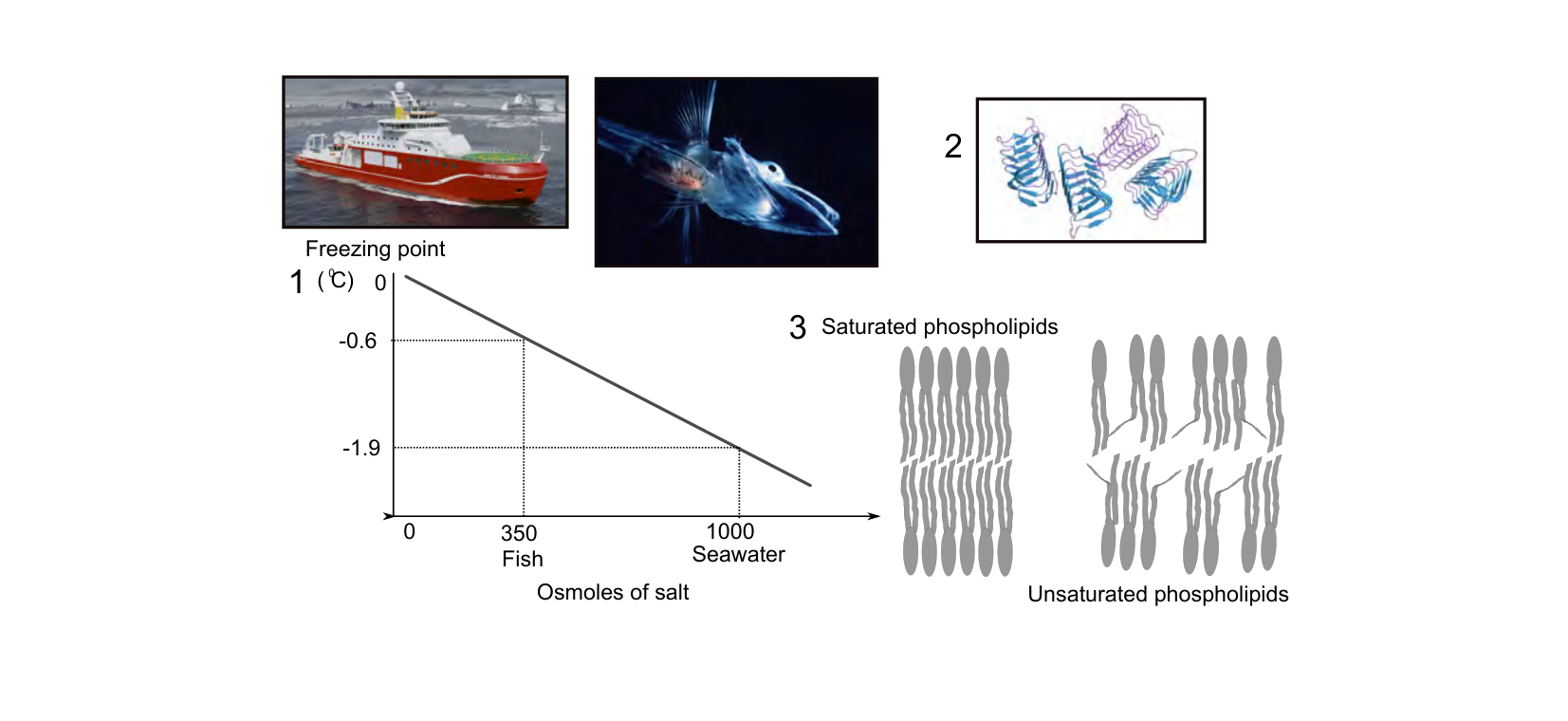
Using the information and data, determine which of the statements are true or which are false.
Question reproduced from IBO 2017, Theoretical Exam B, licensed under CC BY-NC-SA 4.0 - attributed to the International Biology Olympiad. Open the full exam PDF · Official answer key & worked solutions