Lipids & Membrane Biochemistry
Overview
Lipids are defined by a shared physical property (poor water solubility) rather than a shared chemical scaffold the way amino acids or sugars are: which is why “lipid” covers everything from triglycerides to cholesterol to signalling eicosanoids. This page covers the chemistry that matters for membrane structure specifically: fatty acid saturation, the amphipathic phospholipid, and why cholesterol has the paradoxical dual effect of both stiffening and fluidising membranes depending on temperature. Plasma Membrane Structure & Transport covers the resulting bilayer’s transport behaviour; this page covers the chemistry underneath it.
Key Concepts
Fatty acid structure and saturation
A fatty acid is a long hydrocarbon chain terminating in a carboxylic acid group. Saturated fatty acids have no carbon-carbon double bonds, allowing the chain to lie fully extended and pack tightly against neighbouring chains via van der Waals interactions: this tight packing is why saturated fats are typically solid at room temperature. Unsaturated fatty acids contain one (monounsaturated) or more (polyunsaturated) C=C double bonds, almost always in the cis configuration in natural lipids, which introduces a rigid ~30° kink in the chain. That kink prevents tight packing, lowering the melting point, unsaturated fats are typically liquid at room temperature.

Triglycerides: pure energy storage
A triglyceride (triacylglycerol) is glycerol esterified to three fatty acids. Because the molecule is almost entirely hydrocarbon by mass and carries no polar head group, triglycerides pack into anhydrous, extremely energy-dense storage droplets: roughly twice the energy density per gram of glycogen, which by contrast must be stored hydrated (each gram of glycogen holds substantial associated water), making fat the far more mass-efficient long-term reserve, at the cost of slower mobilisation kinetics than glycogen.
Phospholipids: the amphipathic membrane building block
A phospholipid replaces one fatty acid of a triglyceride-like backbone with a phosphate-linked polar head group (e.g. choline, serine, ethanolamine, inositol), producing a molecule with a hydrophilic head and two hydrophobic tails, amphipathic. In water, this amphipathicity drives spontaneous self-assembly into a bilayer: tails face inward, away from water; heads face outward, into the aqueous environment on both sides. This is not an energetically “designed” outcome so much as the thermodynamically favoured configuration: burying the hydrophobic tails minimises the disruption to water’s hydrogen-bond network (the same hydrophobic-effect logic that drives protein tertiary-structure folding, see Protein Structure, Folding & Function).
Head group identity determines membrane leaflet asymmetry and signalling function, not just electrostatics, e.g. phosphatidylserine is normally kept on the cytoplasmic leaflet by ATP-dependent flippases, and its appearance on the outer leaflet is a recognised “eat me” signal for phagocytes during apoptosis (see Cell Junctions, Extracellular Matrix & Cell Death).

Cholesterol and membrane fluidity
Cholesterol is a rigid, planar four-ring sterol that intercalates between phospholipid tails, with its single polar hydroxyl oriented toward the bilayer surface. Its effect on fluidity is temperature-dependent and bidirectional:
- Above the phase-transition temperature (fluid, disordered membrane): cholesterol’s rigid ring system restricts the motion of adjacent fatty acid tails, decreasing fluidity.
- Below the phase-transition temperature (membrane tending toward a rigid, ordered gel state): cholesterol prevents fatty acid tails from packing into a fully ordered crystalline array, increasing fluidity.
Net effect: cholesterol acts as a fluidity buffer, narrowing the range of temperatures over which the membrane’s physical state changes sharply, a frequently mis-simplified concept (“cholesterol makes membranes more fluid”) that is only half correct.


Lipids as signalling molecules
Not all lipid biology is structural. Eicosanoids (prostaglandins, thromboxanes, leukotrienes), derived from the membrane phospholipid-released fatty acid arachidonic acid via the cyclooxygenase (COX) and lipoxygenase pathways, act as short-range paracrine signals in inflammation, pain, and clotting: the pharmacological target of aspirin and other NSAIDs (irreversible/reversible COX inhibitors, respectively, see the irreversible-inhibition mechanism in Enzyme Kinetics & Regulation). Steroid hormones (derived from cholesterol) and phosphoinositide second messengers (e.g. IP₃/DAG, generated by PLC cleavage of PIP₂) extend lipid signalling into gene regulation and intracellular second-messenger cascades (see Cell Signaling & Communication).
Comparative Structures
| Lipid class | Polar head group? | Primary role | Packing consequence |
|---|---|---|---|
| Saturated fatty acid / triglyceride | No | Energy storage | Tight packing, solid at room temp |
| Unsaturated fatty acid / triglyceride | No | Energy storage | Kinked chain, loose packing, liquid at room temp |
| Phospholipid | Yes | Membrane structure | Amphipathic, spontaneous bilayer self-assembly |
| Cholesterol | Minimal (single -OH) | Fluidity buffering | Intercalates between tails, bidirectional fluidity effect |
| Eicosanoids/steroid hormones | Varies | Signalling | Small, diffusible, receptor- or membrane-permeable |
Common Exam Questions
- “Why are unsaturated fats liquid at room temperature?”, always cite the cis double bond kink preventing tight packing, not a vague “different structure” answer.
- “Does cholesterol increase or decrease membrane fluidity?”, the trick answer depends on temperature; a well-posed question will specify above or below the transition temperature, and a well-prepared answer should note the dependency even if not explicitly asked.
- Distinguishing why fat (not glycogen) is the long-term storage molecule of choice hinges on energy density and the anhydrous-vs-hydrated storage argument together, not either alone.
Visual Reference
Interactive
- A phospholipid bilayer self-assembly simulator: scatter phospholipid icons in a 2D “water” field and animate their spontaneous reorganisation into a bilayer, illustrating the hydrophobic-effect argument without requiring a thermodynamics derivation.
Static
(Static images are placed inline in Key Concepts above, next to the concept each one illustrates, rather than collected here.)
Practice Challenge
Competition-sourced practice questions for this topic, graded by difficulty. Click the Solution tab to reveal each answer.
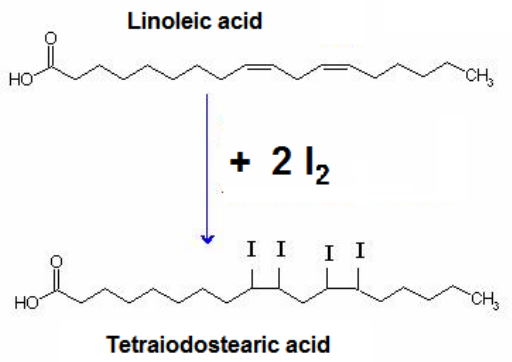
Iodine can react with the carbon-carbon double bonds in unsaturated fatty acids, as shown below when it reacts with linoleic acid.
A 10.0 g sample of arachidonic acid (molecular weight: 304 g/mol) absorbs 33.3 g of iodine (molecular weight: 254 g/mol). How many carbon-carbon double bonds are present per molecule of arachidonic acid (nearest integer)?
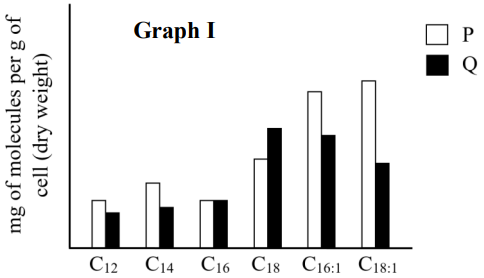
Two bacterial species, P and Q, when analysed for the membrane lipid composition, revealed the following results (graph I):
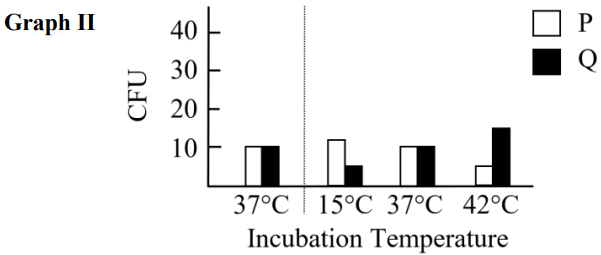
When cells were cultured at 37°C and then shifted either to 15°C or 42°C temperatures, the data for colony-forming units (CFUs) obtained is depicted in graph II.
Indicate whether each of the following interpretation is True or False:A . Fatty acids of lower molecular weight are likely to impart more fluidity to the membrane.B . Unsaturated fatty acids are likely to provide more fluidity to the membrane that is required for cells to grow at higher temperatures.C . Culture P performs better at lower temperature as it has greater energy storage in the form of fatty acids.D . Membrane of bacteria P with more fluidity is likely to outperform Q at all temperatures.E . Weaker hydrogen bonding and increased membrane permeability will be observed in organism P at higher temperatures.
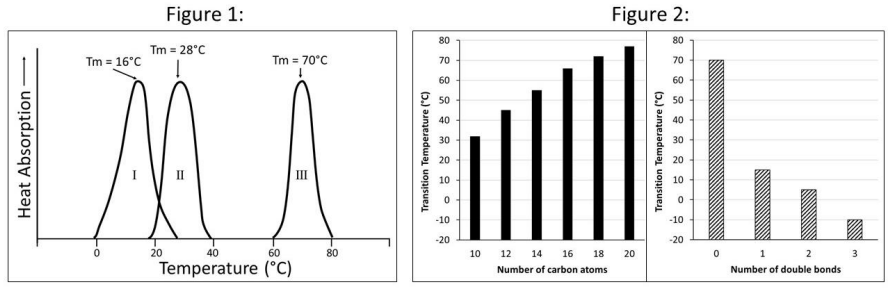
The fluidity of a membrane depends primarily on the kinds of lipids it contains. When the temperature of a typical membrane preparation is increased slowly in a calorimetric chamber, a peak of heat absorption marks the gel-to-fluid transition temperature (Tm). Figure 1 depicts the Tm of three kinds of membranes while figure 2 depicts the effect of chain length and number of double bonds on the Tm of fatty acids.
Mark the correct statement.A . Animals living in sub-zero habitats most likely have fewer double bonds with a chain length of 10 C atoms or more.B . Membranes with oleate enriched fatty acids are essential for homeotherms living in tropical climates.C . Curves I and II represent membranes of terrestrial animals while III represents aquatic animals.D . Membranes with higher stearate content are likely to be less fluidic than those with higher oleate content.
Practice Problems
1. A membrane sample is enriched in polyunsaturated phospholipids compared to a control sample of otherwise identical composition. Predict how its fluidity at a fixed temperature compares to the control, and explain the chemical basis.
Show answer
More fluid. Each additional cis double bond adds another kink to the fatty acid tail, further disrupting tight van der Waals packing between adjacent tails, more unsaturation lowers the effective “melting point” of the membrane, keeping it in a more fluid state at a given temperature than a more saturated membrane would be.
2. Explain why storing the same amount of chemical energy as fat rather than glycogen requires roughly half the mass, referencing both the chemistry of the molecules and how each is stored physically in the body.
3. Phosphatidylserine normally resides on the inner (cytoplasmic) leaflet of the plasma membrane. During apoptosis, it appears on the outer leaflet. What class of membrane protein is most directly implicated in maintaining the normal asymmetric distribution, and what does its loss of function during apoptosis signal to the surrounding tissue?