Q19 - Fibre-Type Composition Explains a Human-Chimp Muscle Trade-off
Hugh Huxley (1924-2013) proposed the sliding filament theory of muscle contraction. Myosin can bind actin filaments, then change conformation, tugging on actin. Skeletal muscle myosin can only generate tension on actin by this change of conformation, and releases actin immediately once it is complete. During each cycle of binding, myosin hydrolyses one ATP molecule.
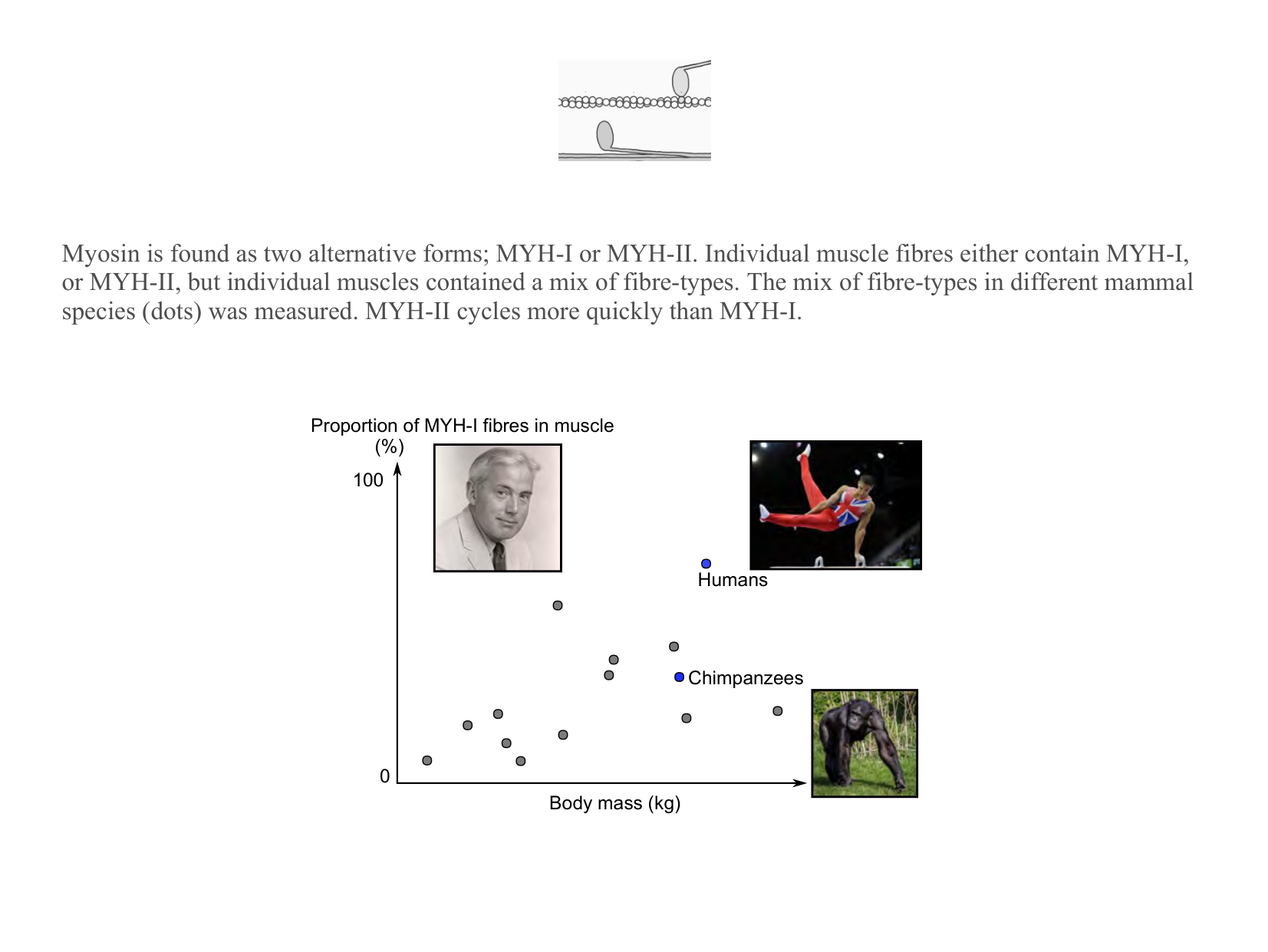
Using the information and data, determine which of the statements are true or which are false.
A. Human muscles contract more quickly than chimp (Pan) muscles when opposed by the same load.
B. A muscle fibre generates more force when it is shortening rapidly, compared to when its shortening is resisted by a load.
C. Chimps generate a greater proportion of the ATP in their muscles aerobically, compared to humans.
D. The most recent common ancestor of humans and chimps is likely to have had muscles more similar to humans’ than chimps’.
E. A tensed muscle that is not shortening, does not consume ATP.
Question reproduced from IBO 2017, Theoretical Exam B, licensed under CC BY-NC-SA 4.0 - attributed to the International Biology Olympiad. Open the full exam PDF · Official answer key & worked solutions