Q24 - Phylogenetic Position of Symsagittifera
Uljanin in 1870, discovered a group of marine, soft-bodied, unsegmented hermaphroditic worms without hindgut and coelom. The mouth in these worms opens to a central digestive parenchyma. They moved with their multiciliated epidermis, although, many were ‘surprisingly muscular’. Most of the species were free-living and some were ectocommensals. It has now been showed that several species form obligate symbioses with green algae, making them functional photoautotroph organisms. Later, phylogenetic position of these multicellular organisms was studied using the complete mitochondrial genome of a member of this group (Symsagittifera roscoffensis) which has been given in the figure below.
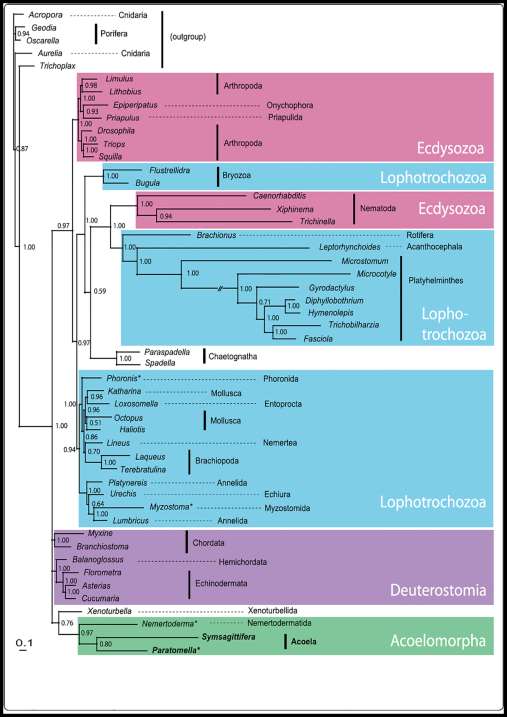 Figure 1.
Using the information and data, determine which of the statements are true or which are false.
Question reproduced from IBO 2018, Theoretical Paper 1, licensed under CC BY-NC-SA 4.0 - attributed to the International Biology Olympiad. Open the full exam PDF · Community solutions (unofficial)