Q25 - Phylogenetic Position of Dicyemids
In 1876, Van Beneden, found a group of microscopic ciliated wormlike organisms that inhabited the renal sacs of cephalopods, mainly octopuses and cuttlefishes and named them as Dicyemids. Biologists have been fascinated because of their highly-simplified body organization and complex life cycles of asexual (under normal condition producing vermiform larva in host kidney) and sexual (under crowded condition producing infusoriform larva excreted in host urine). These ciliated animals are composed of approximately 20-30 (or 40) cells arranged in two layers, and they lack coeloms, circulatory systems, and other differentiated tissues and their embryos employ spiral cleavage. Due to their simple body plans, it can be considered as intermediates between the Protozoa and the Metazoa. The phylogenetic position of dicyemids suggested by previous phylogenetic studies remains controversial.
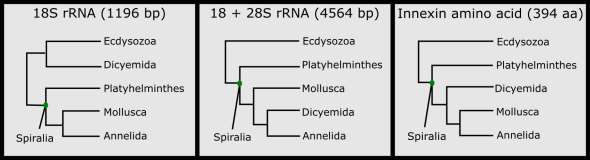 Figure 1.
Using the information and data, determine which of the statements are true or which are false.
Question reproduced from IBO 2018, Theoretical Paper 1, licensed under CC BY-NC-SA 4.0 - attributed to the International Biology Olympiad. Open the full exam PDF · Community solutions (unofficial)