Q28 - Boron-Sugar Complexes and Pollen Tube Growth
Boron (B) is an essential micronutrient for plants. Its uptake, transport, and function in plants appear to be dependent on the formation of B complexes with sugars, such as sorbitol in phloem sap (Fig. 1) and a specific dimerised form of pectin in growing cell walls. Yokota and Konishi (1999) studied the effect of various exogenously supplied sugars including sucrose, glucose, and fructose on promotion of pollen tube growth by formation of sugar-borate complexes. Pollens were cultivated at different concentrations of B for 20 hours. Effect of sugars on the pH of the media is shown in Table 1, and the length of pollen tubes incubated with the various sugars is shown in Fig. 2. Figure 1. Boron-Sorbitol complex Table 1. Changes of the pH values of the pollen culture media containing different sugars after adding boric acid at different concentrations (first row).
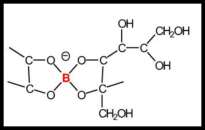 Boron-Sorbitol complex Table 1. Changes of the pH values of the pollen culture media containing different sugars after adding boric acid at different concentrations (first row).
 Figure 2.
Using the information and data, determine which of the statements are true or which are false.
Question reproduced from IBO 2018, Theoretical Paper 1, licensed under CC BY-NC-SA 4.0 - attributed to the International Biology Olympiad. Open the full exam PDF · Community solutions (unofficial)