Q27 - Anthocyanin Pigments in Water Lily Flower Colour
Anthocyanins are vacuolar pigments that consist of two phenyl rings and one heterocyclic ring. They are the source of red to blue colours of flowers and fruits. Changes of vacuolar and soil pH, formation of complexes with metal ions, and introduction of -OH groups particularly at 3’ and 5’ positions and subsequent methylations at these positions all result in production of variations in the colours of the pigments. For example, increase in the number of hydroxyl groups or complex formation with metal ions shifts absorption of the pigments to longer wavelengths, whereas methoxyl groups (OCH3) shift absorption to a slightly shorter wavelengths. Given that plargonidin (1) is the most abundant pigment in the variety A of Tropical Water Lily flowers (Nymphaea spp.) indicate if each of the following statement is true or false.
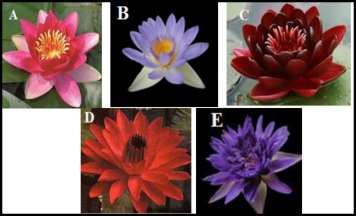 Figure 1.
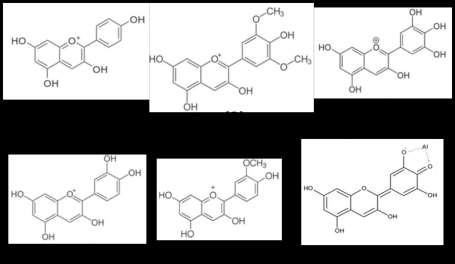 Figure 2.
Using the information and data, determine which of the statements are true or which are false.
Question reproduced from IBO 2018, Theoretical Paper 1, licensed under CC BY-NC-SA 4.0 - attributed to the International Biology Olympiad. Open the full exam PDF · Community solutions (unofficial)