Q1 - Human SNP Haplotype Blocks
The HapMap project was designed to estimate the amount of variation among the genomes of different individuals. One of the outcomes of the project was identification of many SNPs (single nucleotide polymorphisms) in the human genome. It was observed that the vast majority (here, assume all) of SNPs exist as only one of two (not four) nucleotides. Therefore, for a region of the genome consisting of n SNPs, 2n combinations of the SNPs are conceivable. In fact, sequencing of the SNPs in hundreds of individuals has revealed that generally a much lower number of combinations exist. The combinations of SNPs in fact observed in a region of the genome are named the SNP haplotypes of that region. The figure below is a representation of this finding. It shows the genotype of 26 neighbouring SNPs in a region of human chromosome 5 from 20 individuals of different populations throughout the world. Only one copy of chromosome 5 was isolated from each individual. The chromosomes are grouped on basis of having the same combination of genotypes for all the SNPs (i.e. having the same haplotype).
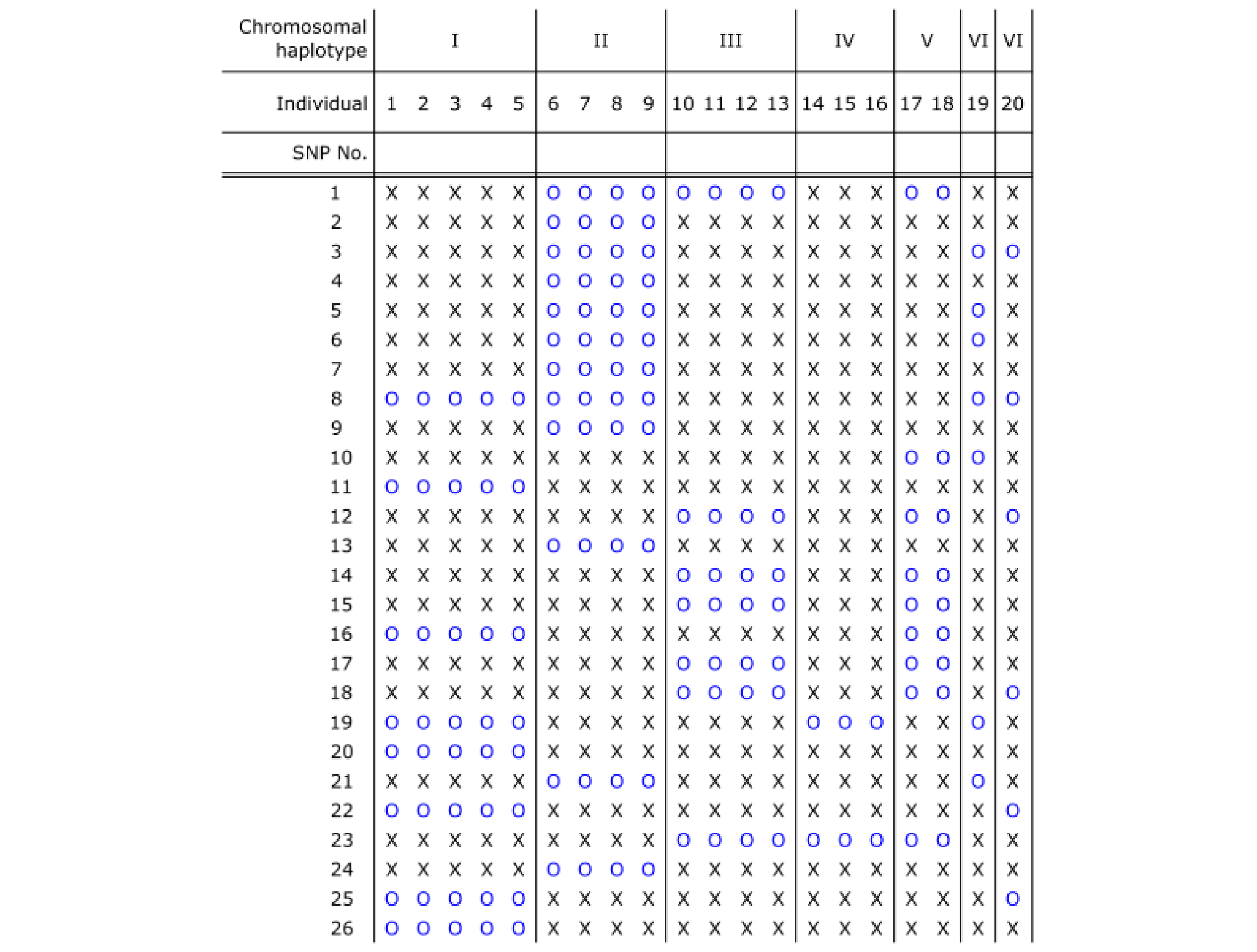 Figure 1.
Using the information and data, determine which of the statements are true or which are false.
Question reproduced from IBO 2018, Theoretical Paper 2, licensed under CC BY-NC-SA 4.0 - attributed to the International Biology Olympiad. Open the full exam PDF · Community solutions (unofficial)