Q26 - Classifying the Novel Taxon Dendrogramma
Dendrogramma is a new animal species which has been collected at 400 and 1000 metres on the Australian continental slope off eastern Bass Strait and Tasmania during a cruise in 1986 and described as a new taxon in 2016. The new taxon is multicellular (metazoan), non-bilaterialian, apparently diploblastic with a dense mesoglea between an outer epidermis and an inner gastrodermis. This animal is composed of a body divided into a stalk with a mouth opening terminally, and a flattened disc. The mouth is set in a specialized, lobed epidermis field, leading into a gastrodermis- lined gastrovascular canal (pharynx) in the stalk which aborally branches dichotomously into numerous radiating canals in the disc. We can state with considerable certainty that the organisms lack cnidocytes, tentacles, marginal pore openings for the radiating canals, ring canal, sense organs in the form of statocysts or the rhopalia, or colloblasts, ctenes, or an apical organ. No cilia have been located. They have simple mouth opening with specialized lobes secreting mucus.
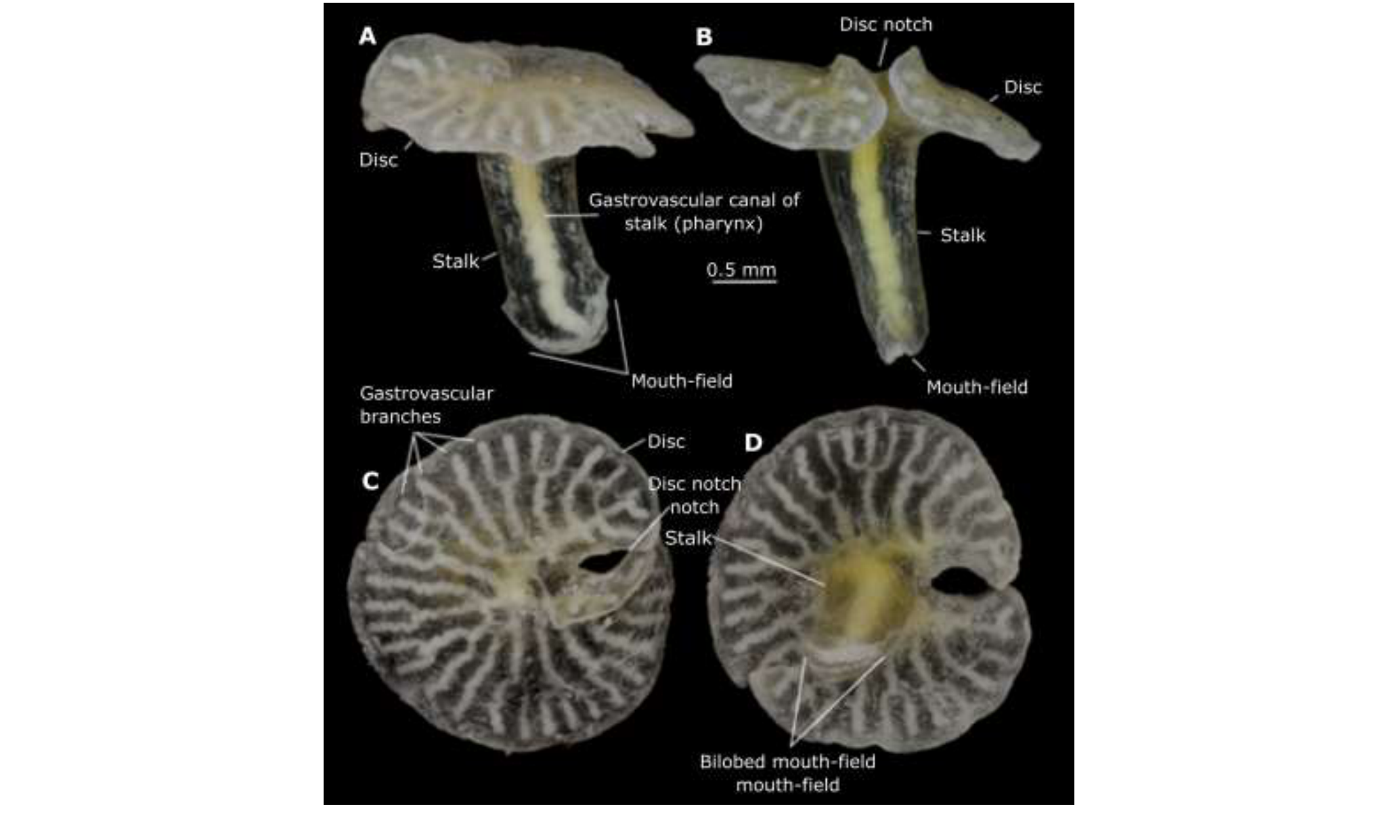 Figure 1.
Using the information and data, determine which of the statements are true or which are false.
Question reproduced from IBO 2018, Theoretical Paper 2, licensed under CC BY-NC-SA 4.0 - attributed to the International Biology Olympiad. Open the full exam PDF · Community solutions (unofficial)