Q36 - Cladistic Analysis of the Plant Genus X
The plant genus X contains 6 species (X. messa, X. obnoxia, X. beatifica, X. confusa, X. foetida, X. nerda). All of them share many character states that distinguish this genus from all closely related genera. The species differ from each other, however, as described below. All species in the sister genus, Y, are vining plants with palmately compound, alternate leaves, sweet-smelling flowers with pink, free petals and 10 stamens, and drupes. X. messa: Plant upright, stems glabrous; leaves opposite, palmately compound; petals purple, free; stamens 5; flowers sweet-smelling; fruit a berry X. obnoxia: Plant vining, stems glabrous; leaves opposite, simple; petals red, free; stamens 10; flowers with a rotten meat smell; fruit a berry X. beatifica: Plant upright, stems glabrous; leaves opposite, palmately compound; petals pink, connate; stamens 5; flowers sweet-smelling; fruit a berry X. confusa: Plant upright, stems glabrous; leaves opposite, simple; petals purple, free; stamens 5; flowers sweet-smelling; fruit a berry X. foetida: Plant vining, stems hispid; leaves opposite, palmately compound; petals red, free; stamens 10; flowers with a rotten meat smell; fruit a berry X. nerda: Plant upright, stems glabrous; leaves opposite, palmately compound; petals pink, connate; stamens 4; flowers sweet-smelling; fruit a berry The data matrix, in which characters are coded according to whether character states are plesiomorphic (0) or apomorphic (1, 2) was presented in the following table. The most parsimonious cladogram was constructed from the data matrix.
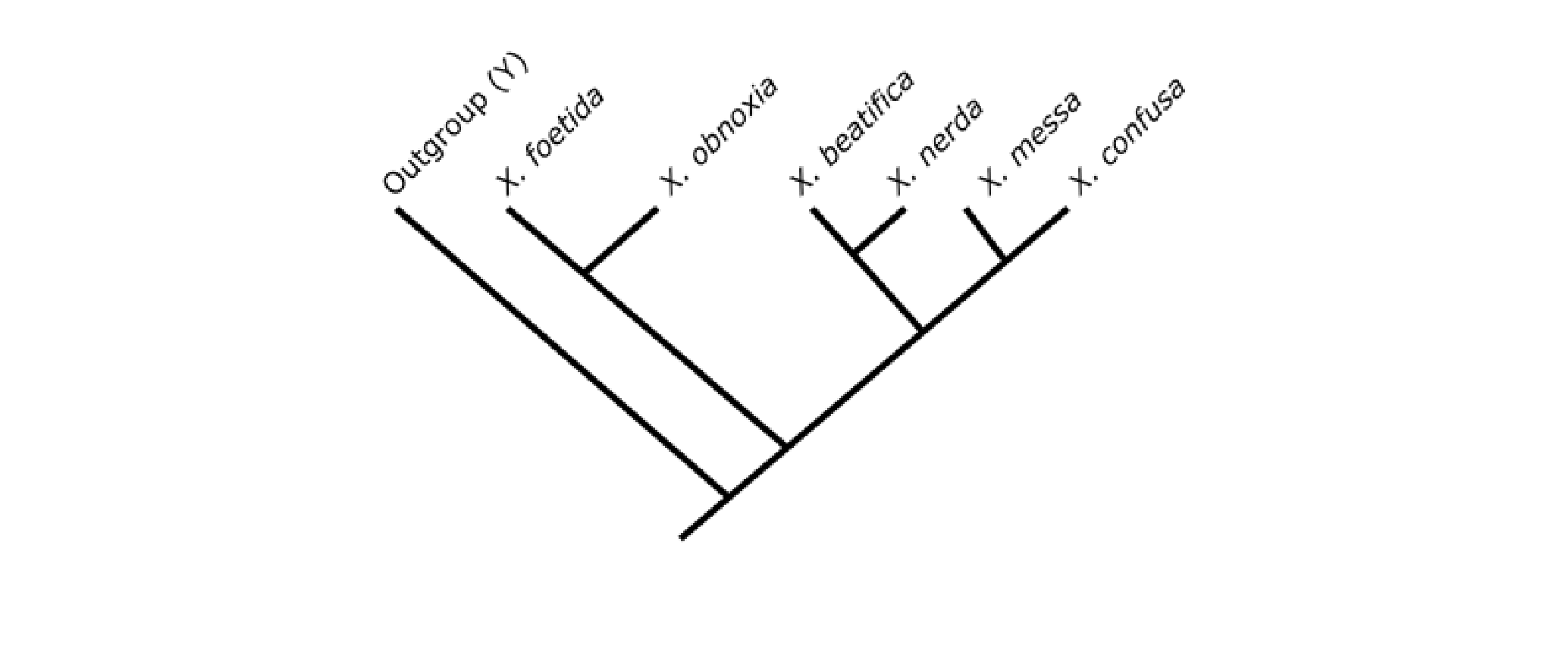 Figure 1.
Using the information and data, determine which of the statements are true or which are false.
Question reproduced from IBO 2018, Theoretical Paper 2, licensed under CC BY-NC-SA 4.0 - attributed to the International Biology Olympiad. Open the full exam PDF · Community solutions (unofficial)