Q45 - Phylogeography of the Indo-European Language Family
There are two hypotheses that try to explain the origin of the Indo-European language family. The Steppe hypothesis traces back the origin of Indo-European language to the Pontic steppes region north of the Caspian Sea. Archaeological records provide some clues regarding to expansion from this area about 6000 years ago, however the implied models of such expansion remain untested. Alternatively, it has been claimed that the languages spread from Anatolia with the development of agricultural activities about 8000 to 9500 years ago (the Anatolian hypothesis). The agricultural expansion reached the edge of Western Europe by 5000 years ago and had run its course about 4000 years ago. Bouckaert and his colleagues (2018) assessed the two hypotheses with Bayesian phylogeographic approaches using vocabulary information from the ancient and contemporary Indo-European languages. Maximum clade credibility tree indicating the divergence of the major Indo-European subfamilies. The tree demonstrates the timing of the appearance of the major branches and their subsequent variation. The area of each triangle represents the relative number of languages in each subfamily.
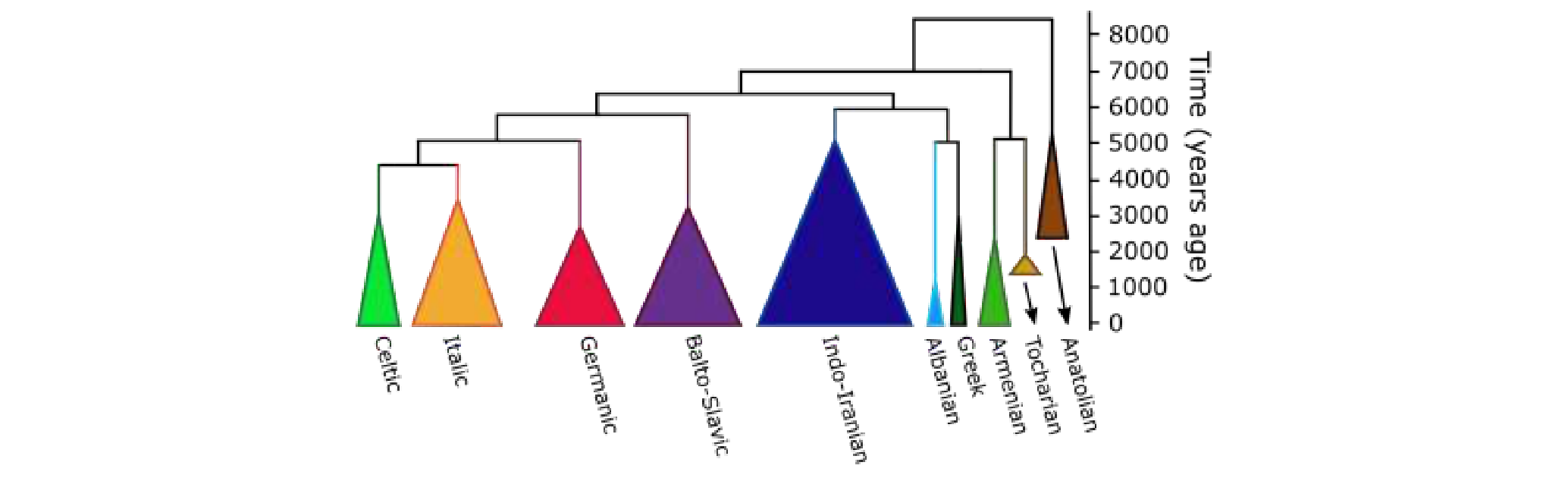 Figure 1.
Using the information and data, determine which of the statements are true or which are false.
Question reproduced from IBO 2018, Theoretical Paper 2, licensed under CC BY-NC-SA 4.0 - attributed to the International Biology Olympiad. Open the full exam PDF · Community solutions (unofficial)