Skip to content
← Theoretical A

Q17 - Feeding Time and the Central vs. Peripheral Circadian Clock

Theoretical A Real exam question - full text reproduced under IBO's CC BY-NC-SA 4.0 license

The impact of feeding on the central circadian clock of the brain, and the peripheral clocks of other cells, was assessed. Mice were either fed only from 6.00-18.00 (daytime feeding) or only from 18.00-6.00 (nighttime feeding). The amount of Per1 and Per2 protein in liver is shown. The central brain clock was stained with labelled DNA complementary to the per1 or per2 sequences.
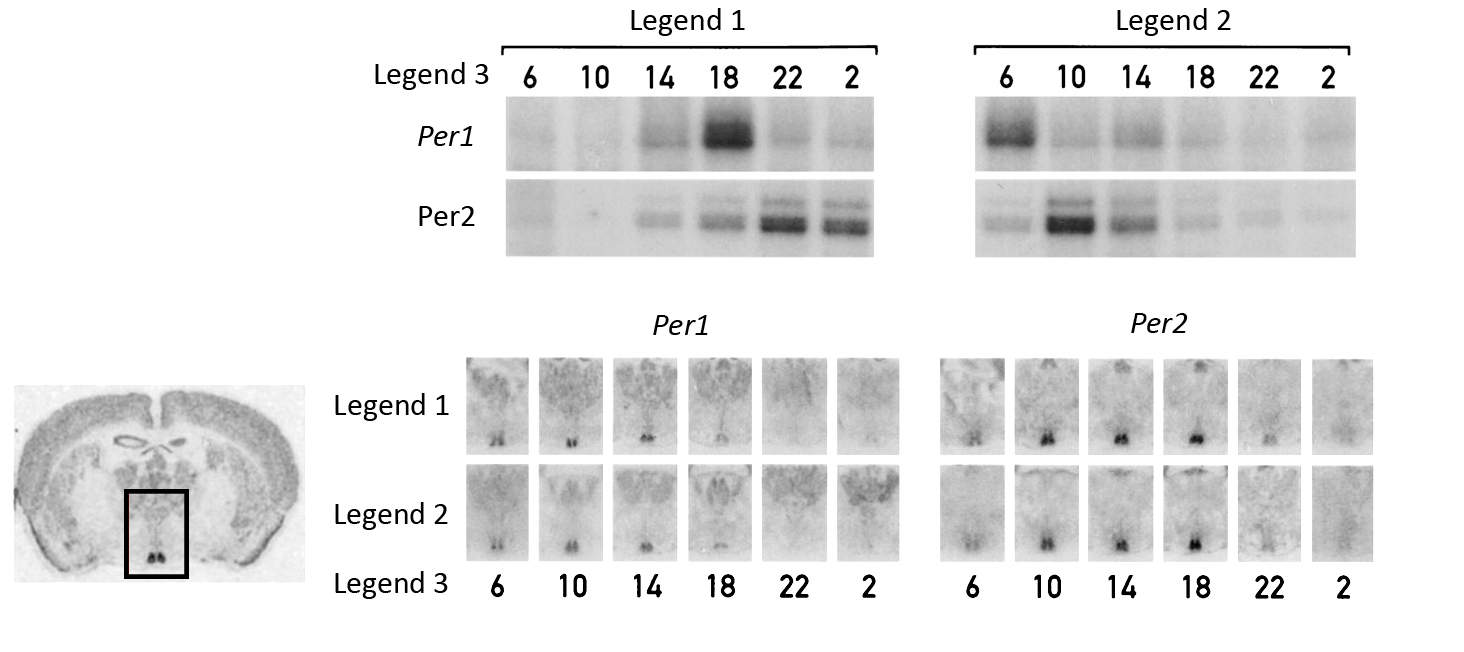
Top: two blot panels (Nighttime feeding, Daytime feeding), each showing Per1 and Per2 protein band intensity across timepoints 6, 10, 14, 18, 22, 2 (hours). Nighttime feeding: Per1 darkest at 18, faint elsewhere; Per2 darkest at 22. Daytime feeding: Per1 darkest at 6; Per2 darkest at 10. Bottom: brain coronal section (small, greyscale) with a boxed region highlighted, plus a grid of small in-situ hybridization images for Per1 and Per2 across the same six timepoints for both feeding conditions, showing a small dark-staining structure of varying intensity per timepoint. Fig.1. Legend 1 = Nighttime feeding. Legend 2 = Daytime feeding. Legend 3 = Time of the day (h).

For the following questions, indicate your answer by putting an X in the appropriate cells of the table on the answer sheet.

Q17.1. Mice fed only 6:00-18:00 (daytime) vs. only 18:00-6:00 (nighttime) show liver Per1/Per2 protein peaking at different times, while central-brain Per1/Per2 staining is tracked separately. How many hours has the PERIPHERAL (liver) circadian rhythm shifted between the two feeding schedules?
Q17.2. How many hours has the CENTRAL (brain) circadian rhythm shifted between the two feeding schedules?
Q17.3. During night feeding, how many hours do central Per1 peaks precede peripheral Per1 peaks?
Q17.4. If animals were instead fed between 14:00-2:00, what time would you expect peripheral Per1 peaks to occur?

Question reproduced from IBO 2019, Theoretical Exam A, licensed under CC BY-NC-SA 4.0 - attributed to the International Biology Olympiad. Open the full exam PDF · Official answer key