Q16 - Cochlear Frequency Coding and Sound Pressure
The Hungarian biophysicist, György Békésy, was awarded the 1961 Nobel Prize for his research on the function of the mammalian cochlea. He showed that each frequency of sound causes a specific part of the basilar membrane to vibrate the most. This point is determined by the resonant properties of the membrane, with narrower parts vibrating more at higher frequencies.
Neurons sense this vibration and encode the sound with two different mechanisms:
- Place code: Each neuron connects to the membrane in one place and signals the presence of the narrow frequency band that causes maximal vibration in that part of the membrane.
- Periodicity code: If the frequency is below 4 kHz, the timing of action potentials in the cochlear nerve is synchronised with individual cycles of the stimulus (this is called phase-locking).
The intensities of audible sounds are expressed in decibel sound pressure level (dB SPL):
$$dB,SPL = 20 \log_{10}\left(\dfrac{\text{Pressure of sound in Pa}}{2 \times 10^{-5}}\right)$$
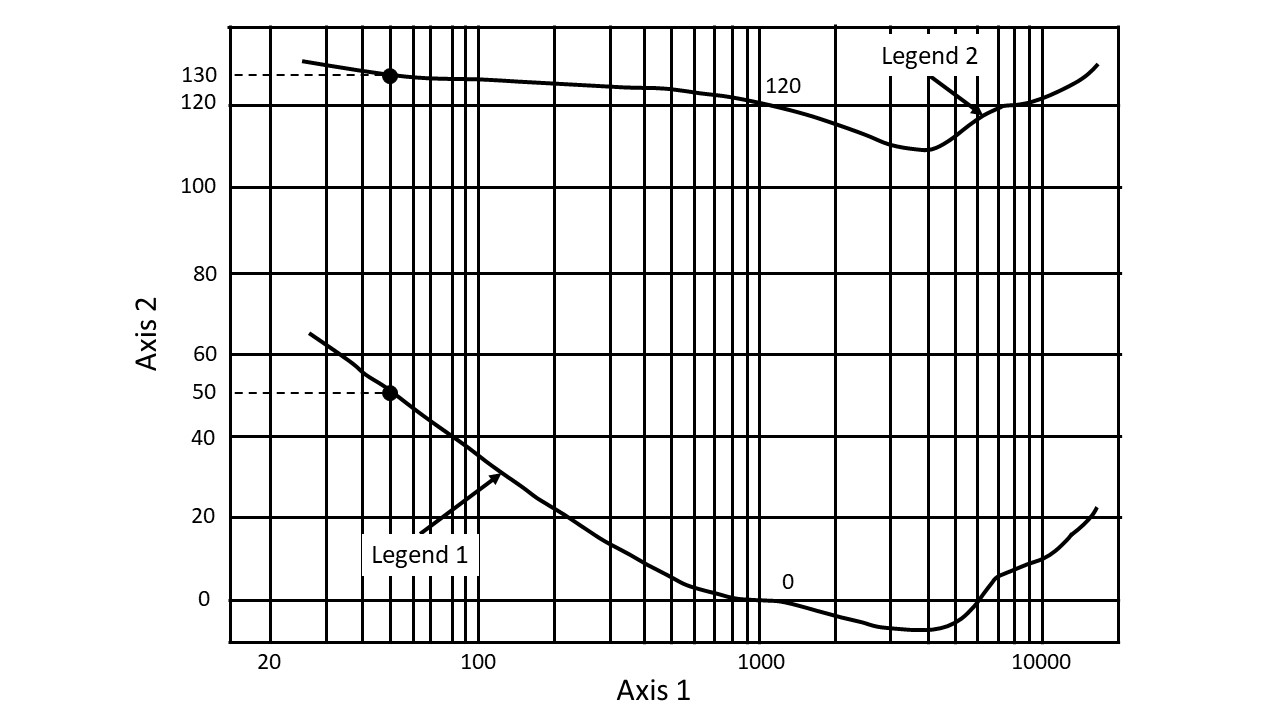 Fig.1. Axis 1 = Frequency (Hz). Axis 2 = Intensity (dB). Legend 1 = Threshold of audibility. Legend 2 = Threshold of pain.
Based on the information above, indicate with an X if each of the following statements is true (T) or false (F).
Question reproduced from IBO 2019, Theoretical Exam A, licensed under CC BY-NC-SA 4.0 - attributed to the International Biology Olympiad. Open the full exam PDF · Official answer key