Q2 - CLK Mutation and Circadian PER Oscillations
Hall, Rosbash and Young were awarded the 2017 Nobel Prize for their discoveries of the molecular mechanisms that control circadian rhythms. ‘Period’ (PER) is a gene of the Drosophila that undergoes strict circadian oscillations. Mutations to PER alter or abolish the periodicity and phase of these rhythms. Another gene regulating the circadian rhythm is ‘clock’ (CLK). Drosophila with a certain mutation in the CLK gene sometimes have disrupted circadian rhythms as shown in Table 1.
| Condition | Genotype | Period of activity (h) | % arrhythmic |
|---|---|---|---|
| 12 hr light : 12 hr dark | CLK +/+ | 24.3 | 0 |
| 12 hr light : 12 hr dark | CLK +/- | 24.3 | 36 |
| 12 hr light : 12 hr dark | CLK -/- | 24.2 | 86 |
| Constant darkness | CLK +/+ | 24.3 | 1 |
| Constant darkness | CLK +/- | 24.8 | 47 |
| Constant darkness | CLK -/- | ARR (arrhythmic) | 100 |
Table 1.
Cloning revealed that these identified CLK mutant flies have a premature stop codon that truncates the protein, making it non-functional. To determine the in vivo regulatory pattern of the PER gene, they generated transgenic Drosophila strains carrying a luciferase cDNA fused to the promoter region of the PER gene. Then they assayed the activity of luciferase (quantified in counts/s) in Drosophila of the various CLK genotypes. Results are shown in Figure 1. Note that the luciferase activity is proportional to the expression of the examined gene.
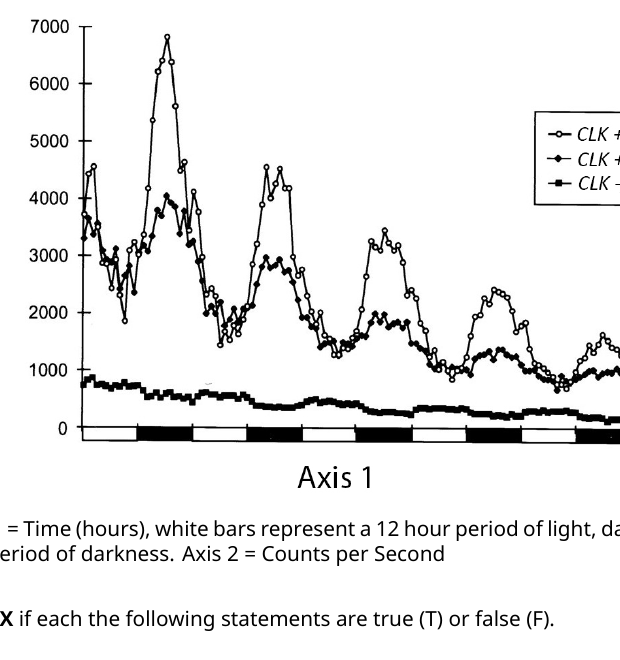 Fig.1. Axis 1 = Time (hours), white bars represent a 12 hour period of light, dark bars represent a 12 hour period of darkness. Axis 2 = Counts per Second.
Indicate with an X if each of the following statements are true (T) or false (F).
Question reproduced from IBO 2019, Theoretical Exam A, licensed under CC BY-NC-SA 4.0 - attributed to the International Biology Olympiad. Open the full exam PDF · Official answer key