Q3 - GPCR Signalling and a Toxin Acting on the Gs Cycle
G protein-coupled receptors (GPCRs) interact with G proteins that subsequently affect cell function through the generation of second messengers. Cyclic AMP (cAMP) generated by adenylyl cyclase controls cell functions via activation of protein kinases. GPCRs may either activate or inhibit the cyclase through the G proteins Gs and Gi, respectively. The difference between Gs and Gi resides in the α subunit, which binds and hydrolyses GTP. The Gs protein cycle is illustrated below.
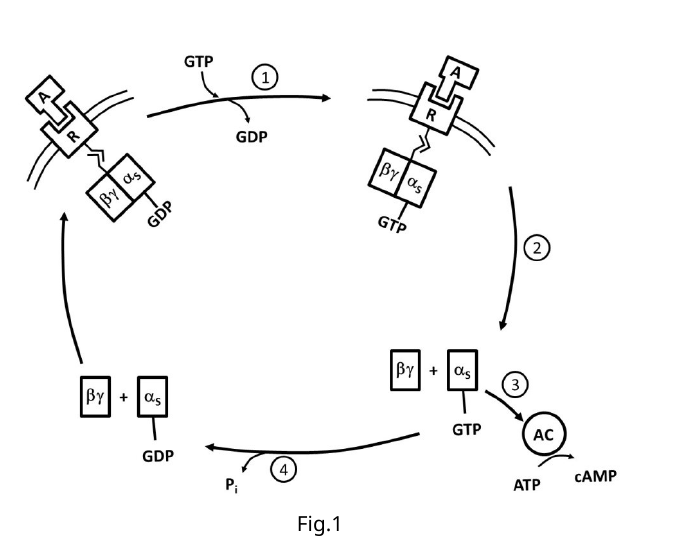 Fig.1.
A lab is working on a pair of newly identified GPCRs, “GPCR-A” and “GPCR-B”. Each binds the same small ligand with the same affinity but activates different G-proteins that act on adenylyl cyclase. When activated, GPCR-A causes an increase in adenylyl cyclase activity, while GPCR-B causes a decrease in adenylyl cyclase activity. They have a cell line that expresses both GPCR-A, GPCR-B, the corresponding G-proteins, and adenylyl cyclase. There is a basal level of adenylyl cyclase activity that produces a baseline cAMP concentration.
A member of the lab studying a pathogenic bacterium has discovered that it secretes a toxin that interferes with the mentioned signalling pathway. To determine how this toxin acts, she did an experiment in which she looked at intracellular cAMP levels in untreated and toxin treated cells (the original ligand of the receptors was not added in either of the experiments).
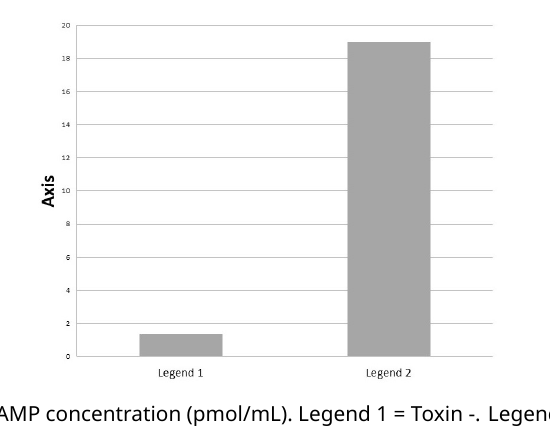 Fig.2. Axis = cAMP concentration (pmol/mL). Legend 1 = Toxin −. Legend 2 = Toxin +.
Indicate with an X whether each of the following mutations increase (A), leave not changed (B), or decrease (C) the intracellular levels of cAMP upon ligand addition, in the absence of the toxin. Remember, both GPCR-A and GPCR-B bind the same ligand! (Q3.1–Q3.6)
What is/are the possible explanation(s) for the mechanism by which the toxin affects adenylyl cyclase activity, based on Fig.2? Indicate TRUE or FALSE for each. (Q3.7–Q3.11)
Question reproduced from IBO 2019, Theoretical Exam A, licensed under CC BY-NC-SA 4.0 - attributed to the International Biology Olympiad. Open the full exam PDF · Official answer key