Q26 - Inheritance of Sterility in a Pedigree
The pedigree shows inheritance of a trait in a model organism. Symbols: empty circle = healthy female; empty square = healthy male; filled (grey) circle = sterile female; filled (grey) square = sterile male.
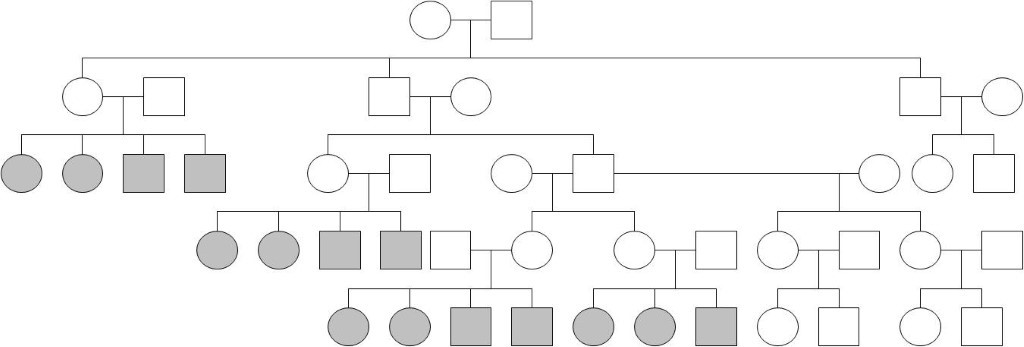 Fig.1.
The change giving rise to sterility can be explained either through a loss-of-function or a gain-of-function mutation of the affected gene.
Q26.1. A pedigree shows inheritance of sterility (filled circle = sterile female, filled square = sterile male) in a model organism, spanning several generations, with affected individuals scattered in a pattern that doesn't fit any single simple Mendelian rule cleanly. Which mode of inheritance explains the pattern?
Q26.2. Assuming a loss-of-function mutation causes sterility, mark every individual in the pedigree who is certainly heterozygous for the mutant allele.
Every unaffected (empty-symbol) parent who has at least one sterile (filled-symbol) child, across all generations shown.: For a loss-of-function (typically recessive-acting at the individual level, but maternal-effect on offspring) allele, an unaffected individual that still produces an affected offspring must be carrying (and passing on) the mutant allele, i.e. must be heterozygous. Individuals with no affected offspring, or who are homozygous mutant themselves, can't be inferred this way from the pedigree alone.
Q26.3. Assuming instead a gain-of-function mutation causes sterility, mark every individual who is certainly heterozygous for the mutant allele.
Every unaffected (empty-symbol) parent who has at least one sterile (filled-symbol) child, across all generations shown, the same logical rule as Q26.2, just under the gain-of-function assumption.: The same inference rule applies regardless of loss- vs. gain-of-function: an unaffected individual can only pass on the mutant allele to affected offspring if it is itself heterozygous, what differs between the two scenarios is only the dominance mechanism at the molecular level, not which pedigree positions are inferably heterozygous.
Question reproduced from IBO 2019, Theoretical Exam A, licensed under CC BY-NC-SA 4.0 - attributed to the International Biology Olympiad. Open the full exam PDF · Official answer key