Q25 - The Luria–Delbrück Replica Plating Experiment
Genetics and Evolution
A test tube contains a suspension of bacteria that were never exposed to the antibiotic kanamycin. The bacteria were spread onto a so-called master plate, which contains nutrients for the bacteria and does not contain kanamycin. Millions of colonies (descendants of a single founder bacterium) developed on the master plate. Replicas (copies) of the master plate colonies were stamped - with a sterile velvet plate - onto three replica plates that contained growth medium supplemented with kanamycin.
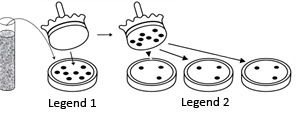 Fig.1. Legend 1 = Master plate. Legend 2 = Replica plates.
Indicate with an X if each of the following statements are true (T) or false (F).
(Note: the original Q.25.6 was redacted by IBO itself in the official materials and is omitted here.)
Question reproduced from IBO 2019, Theoretical Exam A, licensed under CC BY-NC-SA 4.0 - attributed to the International Biology Olympiad. Open the full exam PDF · Official answer key