Q5 - UCP Family and Non-Shivering Thermogenesis
One way of heat production is non-shivering thermogenesis, mediated by norepinephrine via upregulation of mitochondrial uncoupling channel proteins (UCP) in brown adipose tissue (BAT). UCP increases the H⁺ conductance of the inner mitochondrial membrane to dissipate the mitochondrial H⁺ gradient and convert the energy of substrate oxidation into heat. To identify the member(s) of the UCP family responsible for the process, we carried out two experiments.
Figure 1 compares relative effects of acclimation to a cool environment for mice (from thermoneutrality at 30°C to the relative cold of 18°C) on the mRNA levels of different members of the uncoupling protein family in BAT.
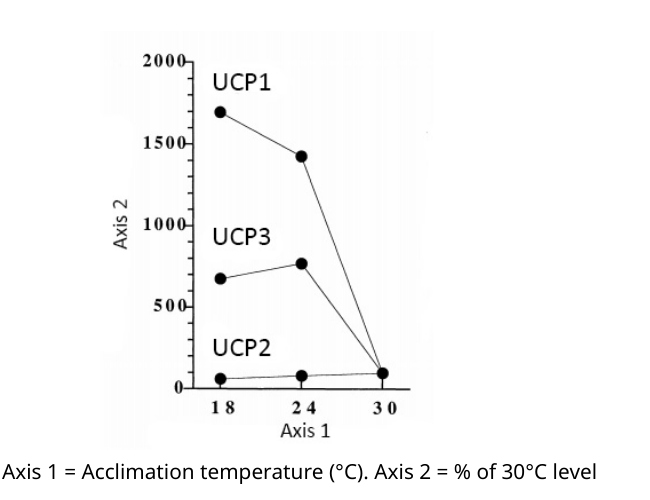 Fig.1. Axis 1 = Acclimation temperature (°C). Axis 2 = % of 30°C level.
In a following experiment, three transgenic mouse strains were generated, bearing a single knock out mutation of either UCP1 or UCP3 and another bearing knock out mutations of both UCP1 and UCP3. We then measured metabolic rate in warm acclimated (30°C) and cool acclimated (18°C) conditions. In each case, besides the basal metabolic rate, we also measured metabolic rate following the injection of norepinephrine (NE).
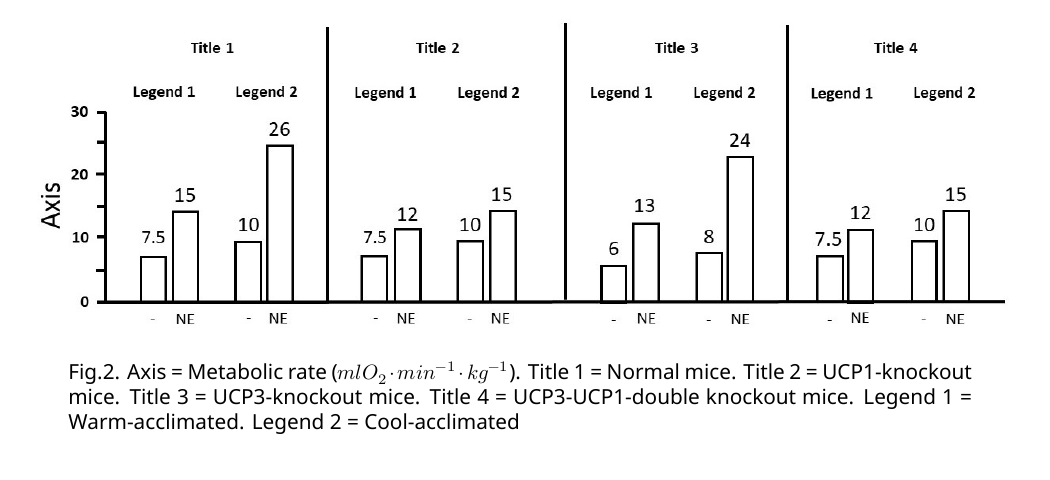 Fig.2. Axis = Metabolic rate (ml O₂·min⁻¹·kg⁻¹). Title 1 = Normal mice. Title 2 = UCP1-knockout mice. Title 3 = UCP3-knockout mice. Title 4 = UCP3-UCP1-double knockout mice. Legend 1 = Warm-acclimated. Legend 2 = Cool-acclimated.
Question reproduced from IBO 2019, Theoretical Exam A, licensed under CC BY-NC-SA 4.0 - attributed to the International Biology Olympiad. Open the full exam PDF · Official answer key