Q27 - Finding the Minimal Reprogramming Gene Set for Fibroblasts
A researcher aimed to induce undifferentiated cells by expressing multiple genes in human fibroblasts. They focused on 24 genes that were identified as highly expressed in embryonic stem (ES) cells. It was found that when all 24 genes were simultaneously introduced in fibroblasts, the colony formation characteristics of undifferentiated cells occurs. Next the researchers tried to find the minimum set of genes that induce undifferentiated cells. The graph shows the colony formation when 23 genes except one were introduced into fibroblast cells. (“All” on the X axis shows that the 24 genes are all introduced.)
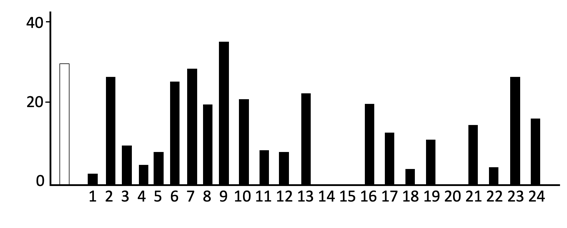 Figure 1.
Using the information and data, determine which of the statements are true or which are false.
Question reproduced from IBO 2020, Theoretical Exam 1, licensed under CC BY-NC-SA 4.0 - attributed to the International Biology Olympiad. Open the full exam PDF · Community solutions (unofficial)