Gene Regulation: Eukaryotic & Epigenetics
Overview
Eukaryotic gene regulation operates across more layers than the prokaryotic operon model covered in Gene Regulation: Prokaryotic: DNA is packaged into chromatin (adding a structural accessibility layer regulation must first contend with), regulatory sequences can act at a distance from the promoter, and heritable regulatory states can persist across cell divisions without any change to the underlying DNA sequence at all (epigenetics). This page covers those additional layers in roughly the order a gene’s expression state is actually determined: chromatin accessibility first, then sequence-specific regulatory input, then RNA-level regulation.
Key Concepts
Chromatin as the first regulatory layer
Eukaryotic DNA is packaged around histone protein octamers into nucleosomes, the repeating unit of chromatin, and this packaging itself is regulatory, not merely structural/space-saving, because RNA polymerase and transcription factors generally cannot access DNA tightly wound around histones. Chromatin exists on a spectrum from heterochromatin (densely packed, transcriptionally silent) to euchromatin (loosely packed, transcriptionally accessible), and a gene’s position on this spectrum is itself a major regulatory determinant, independent of the gene’s own promoter/operator sequence.

Histone modification
Histone tails protruding from the nucleosome core are subject to numerous covalent modifications, collectively constituting a regulatory “code” read by other proteins:
- Acetylation (added by histone acetyltransferases, HATs; removed by histone deacetylases, HDACs) neutralises the histone tail’s normal positive charge, weakening its electrostatic attraction to negatively charged DNA, loosening chromatin and generally promoting transcription. This is the direct mechanistic link between HDAC inhibitor drugs (used in some cancer therapies) and altered gene expression: blocking deacetylation keeps chromatin in a more open, transcriptionally active state.
- Methylation of histone tails has context-dependent effects: the same type of modification (methylation) can either activate or repress transcription depending on precisely which histone residue is methylated and how many methyl groups are added, a nuance worth flagging explicitly since it’s a common oversimplification to treat “histone methylation” as having one uniform effect the way acetylation’s effect is more consistently activating.
DNA methylation
Direct DNA methylation, addition of a methyl group, typically to cytosine in a CpG dinucleotide context, is generally associated with transcriptional silencing, particularly when concentrated in promoter-region “CpG islands.” DNA methylation patterns are actively maintained and can be copied to the new strand after DNA replication (via maintenance methyltransferases recognising hemimethylated DNA immediately post-replication), which is the molecular basis for methylation patterns being heritable across cell divisions without any change to the underlying DNA sequence: the defining property of an epigenetic mark. This is also the mechanistic basis of X-inactivation (one of the two X chromosomes in female mammalian cells is transcriptionally silenced, largely via DNA methylation and heterochromatin formation, maintained stably across all descendant cells of that lineage) and of genomic imprinting (parent-of-origin-specific gene silencing via methylation, meaning the maternal and paternal copies of an imprinted gene are not equivalently expressed).
Enhancers, transcription factors, and the Mediator complex
Beyond chromatin accessibility, eukaryotic transcription is regulated by sequence-specific DNA elements and the proteins that bind them:
- Enhancers are regulatory DNA sequences that can be located far from, even many kilobases away from, or downstream of, the gene they regulate, unlike a bacterial operator’s fixed proximity to its operon. Enhancers work by DNA looping, physically bringing the bound activator proteins into contact with the promoter-bound transcription machinery despite the linear sequence distance.
- Transcription factors bind specific DNA sequences (enhancers, promoter-proximal elements) and either recruit or block the assembly of the transcription machinery. Eukaryotic gene expression is typically controlled combinatorially, a given gene’s expression pattern depends on the specific combination of multiple transcription factors present in a given cell type, rather than any single factor acting alone; this combinatorial logic is the molecular basis for how a limited number of transcription factor proteins can specify the vast diversity of eukaryotic cell types and tissue-specific expression patterns.
- The Mediator complex physically bridges enhancer-bound transcription factors and the general transcription machinery at the promoter (introduced in Transcription & RNA Processing), functionally completing the loop that lets a distant enhancer influence promoter activity.

Regulatory non-coding RNA
Beyond mRNA, tRNA, and rRNA, eukaryotic cells use small regulatory RNAs to control gene expression post-transcriptionally:
- microRNA (miRNA): endogenously encoded small RNAs that base-pair with partially complementary sequences in target mRNAs (typically in the 3′ untranslated region), recruiting the RNA-induced silencing complex (RISC) to block translation or promote mRNA degradation.

- siRNA (small interfering RNA): mechanistically similar to miRNA (also RISC-dependent), but typically derived from fully complementary, often exogenous or experimentally introduced double-stranded RNA, and generally acting through more precise, often complete target mRNA degradation rather than translational repression: the basis of the widely used experimental RNA interference (RNAi) gene-knockdown technique.
Both pathways illustrate that eukaryotic gene regulation extends past transcriptional control into direct, sequence-specific post-transcriptional silencing, a regulatory layer with no direct prokaryotic operon equivalent.
Comparative Structures
| Regulatory layer | Mechanism | Reversible/heritable across divisions? |
|---|---|---|
| Chromatin state (hetero-/euchromatin) | Packaging density affecting accessibility | Yes, and can be epigenetically heritable |
| Histone acetylation | Charge neutralisation, generally activating | Reversible (HAT/HDAC balance) |
| Histone methylation | Context-dependent (activating or repressing) | Reversible, context-dependent persistence |
| DNA methylation | CpG methylation, generally silencing | Yes, actively copied post-replication, the clearest epigenetic mark |
| Enhancer/transcription factor binding | Sequence-specific, combinatorial, DNA looping | Not itself heritable, depends on ongoing TF availability |
| miRNA/siRNA | Post-transcriptional, RISC-mediated | Not a heritable chromatin mark, acts each generation via new RNA transcription |
Common Exam Questions
- “What makes a regulatory mark ’epigenetic’ specifically?”: the defining criterion is heritability across cell division without a change in DNA sequence, DNA methylation is the clearest example because maintenance methyltransferases actively propagate the pattern post-replication.
- “Why can an enhancer regulate a gene located many kilobases away?”: the answer must invoke DNA looping bringing the enhancer and promoter into physical proximity, mediated by the Mediator complex and bound transcription factors, not simply “enhancers work at a distance” without the looping mechanism.
- “Why does histone acetylation generally promote transcription?”: charge neutralisation loosening histone-DNA electrostatic attraction is the expected mechanistic answer, not simply “it opens chromatin” without the underlying reason.
- Distinguishing miRNA (often partial complementarity, translational repression) from siRNA (often full complementarity, mRNA degradation, exogenous/experimental origin) is a frequent classification question, though note both converge on the same RISC machinery.
Visual Reference
Interactive
- A chromatin accessibility toggle: switch a nucleosome-wrapped gene between heterochromatin and euchromatin states (via a histone acetylation slider) and observe transcription factor/polymerase access change accordingly.
Static
(Static images are placed inline in Key Concepts above, next to the concept each one illustrates, rather than collected here.)
Practice Challenge
Competition-sourced practice questions for this topic, graded by difficulty. Click the Solution tab to reveal each answer.
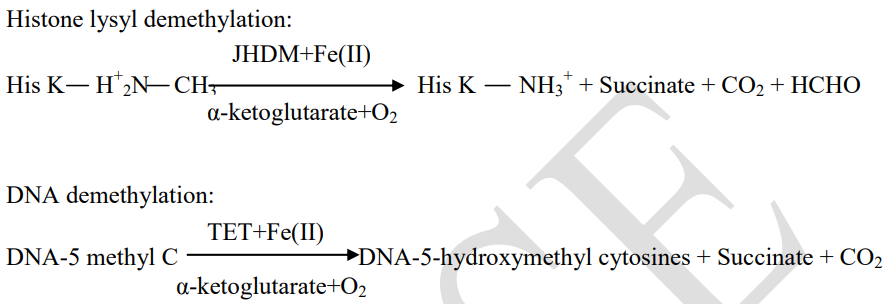
Methylation of cytosine in DNA and lysine residues in histones are the two important epigenetic marks on the chromatin that determine majority of the biological processes, such as embryonic development, stem cell differentiation and cell division cycles. Also, indiscriminate hypermethylation is often associated with tumorigenesis. These methyl DNA from S1 cells DNA from S2 cells 17 marks are removed by enzymes known as dioxygenases. TET (Ten-Eleven Translocation) and Jumonji domain containing histone demethylases (JHDM) remove methyl groups from DNA and histones, respectively. (His K represents histones with lysine.) Two reactions are shown below:
Indicate whether each of the following is true or false:A . Loss of function mutation in the gene that codes for isocitrate dehydrogenase will lead to hypermethylation of DNA and histones.B . Translocation of specific chromosome regions between chromosome 10 and 11 can lead to formation of tumor.C . Overexpression of JHDM in a cell will lead to metabolic imbalance and oxidative stress.D . Krebs cycle operates in the mitochondrial matrix and chromatin modifications take place in the nucleus and hence the two processes are independent.
Dame Jean Thomas (1942-present) discovered that eukaryotic DNA is tightly wrapped around histone proteins. Sir Adrian Bird (1947-present) helped explain the epigenetic marks of DNA. For example, the classical histone H2A, can be replaced by a variant, H2A.Z. H2A.Z occupancy on a pro-flowering gene (1) in Arabidopsis plants (2) of the same age, at different temperatures, was measured.
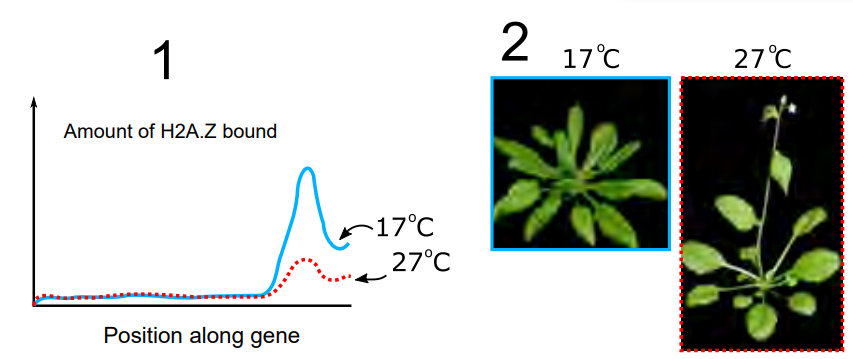
Indicate if the following statements are true or false:A. Increasing temperature increases pro-flowering gene expression.
B. H2A.Z enhances gene expression.
C. Temperature moves the locations to which H2A.Z binds in the genome.
D. Plants that flower early may have increased H2A.Z occupancy in this gene before flowering.
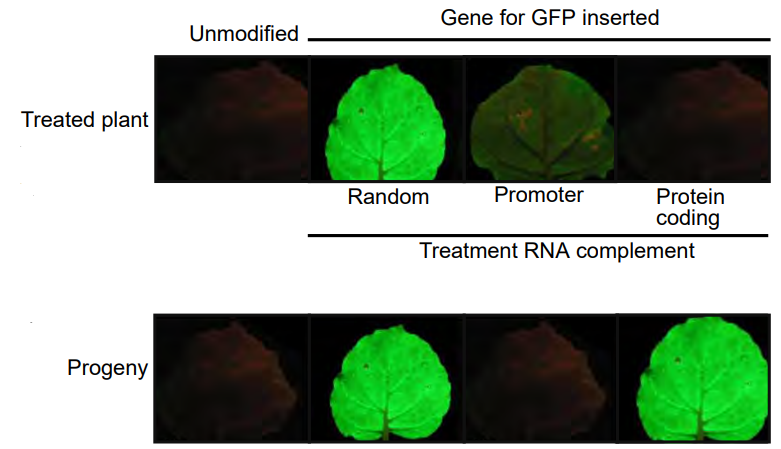
Sir David Baulcombe (1952-present) discovered RNA-directed gene silencing. The gene for green fluorescent protein (GFP) was inserted into plants. The plants were treated with RNAs, which silence GFP, and were then allowed to set seed (the treatment RNAs are not present in the next generation). The treatment RNA sequence was complementary to either the promoter or the protein coding sequences of GFP, or random (non-complementary). The parent plants, their progeny, and controls were imaged under a UV light.
Indicate if each of the statements are true or false:A. Leaves expressing GFP appear darker under UV light.
B. RNA-directed gene silencing is possible without using treatment RNAs designed to target mRNA.
C. Changes in the expression level of genes can be inherited from one generation to the next without mutating the DNA sequence.
D. Silencing against the protein coding sequence is heritable.
Practice Problems
1. A gene’s promoter-region CpG island is found to be heavily methylated in one cell type but unmethylated in another, closely related cell type, despite both cells carrying an identical DNA sequence at this locus. Explain how this is possible, and predict the expected difference in this gene’s expression between the two cell types.
Show answer
DNA methylation is an epigenetic mark, layered on top of (not encoded within) the DNA sequence itself: the same sequence can carry different methylation states in different cell types because each cell lineage’s methylation pattern is independently established during development and then actively maintained across subsequent divisions by maintenance methyltransferases, without requiring any change to the underlying sequence. The heavily methylated cell type is expected to show silenced (little or no) expression of this gene, since promoter CpG island methylation is generally associated with transcriptional repression; the unmethylated cell type is expected to permit normal expression, assuming other regulatory requirements (chromatin accessibility, transcription factor availability) are also met.
2. A researcher treats cultured cells with an HDAC inhibitor. Predict the general effect on global gene expression patterns, and explain the mechanism connecting the drug’s molecular target to this outcome.
3. Explain why combinatorial transcription factor control, rather than one dedicated transcription factor per gene, is a more efficient strategy for specifying the very large number of distinct cell types found in a complex multicellular eukaryote.