Q31 - Grafting Analysis of Strigolactone Biosynthesis and Perception in MAX Mutants
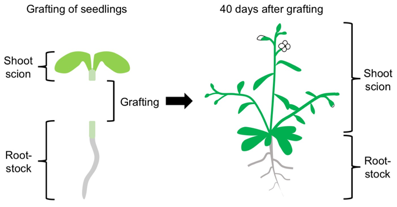
Strigolactone (SL) is a plant hormone that controls shoot branching. In Arabidopsis thaliana, several SL-related mutants, such as max1, max2, and max4, which have loss-of-function mutations in the genes MAX1, MAX2, and MAX4, respectively, have been isolated. While MAX2 encodes a key component of the SL receptor complex, MAX1 and MAX4 each encode an enzyme for SL biosynthesis (Figure 1); MAX4 for the production of the SL precursor carlactone (CL), and MAX1 for the conversion of CL into SL. Grafting experiments using these mutants and the wild type (WT) were conducted, and the number of shoot branches were counted (Figure 2 & 3). In this experiment, neither mRNAs nor proteins of the MAX genes were found to move across the grafting junction.
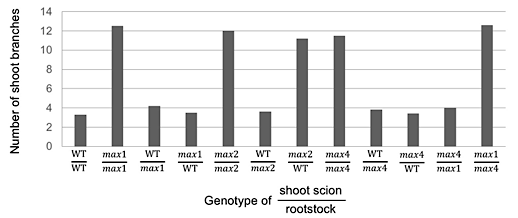 Figure 1.
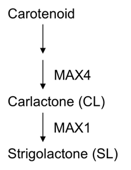 Biosynthetic pathway of strigolactone Schematic illustration of grafting experiments
 Number of shoot branches in the grafted plants 42
Using the information and data, determine which of the statements are true or which are false.
Question reproduced from IBO 2020, Theoretical Exam 1, licensed under CC BY-NC-SA 4.0 - attributed to the International Biology Olympiad. Open the full exam PDF · Community solutions (unofficial)