Q30 - Systemin and Jasmonate Signaling in the Tomato Wound Response
When tomato leaves are wounded, the expression of protease inhibitor genes is induced and protease inhibitor proteins accumulate in the leaves. This response contributes to defense against insect herbivory as the protease inhibitor proteins suppress the digestive function of insects. Since this response occurs not only in damaged leaves but also in undamaged leaves, it is assumed that some mobile molecules transmit wound signals over long distances. Jasmonate and systemin, a signaling peptide composed of 18 amino acids, are involved in wound-induced expression of protease inhibitor genes. Indeed, neither systemin-insensitive mutant (spr1), jasmonate biosynthesis-deficient mutant (spr2), nor jasmonate-insensitive mutant (jai1) show expression of protease inhibitor genes after wounding. To investigate the roles of jasmonate and systemin in the long-distance signaling, experiments with grafts between wild-type and mutant plants were conducted. Leaves of the stock were subjected to wounding and then the expression of protease inhibitor genes were assayed, both in damaged leaves of the stock and in undamaged leaves of the scion (Figure 1). The results are summarized in Table 1.
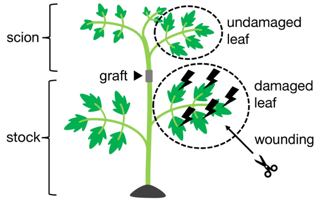 Schematic illustration of graft experiments 40 Table 1
Using the information and data, determine which of the statements are true or which are false.
Question reproduced from IBO 2020, Theoretical Exam 1, licensed under CC BY-NC-SA 4.0 - attributed to the International Biology Olympiad. Open the full exam PDF · Community solutions (unofficial)