Q37 - Gene Duplication and Selection in Primate ECP/EDN Ribonuclease Genes
The following figure is a phylogenetic tree of ECP and EDN genes in primates. EDN shows strong ribonuclease activity. By contrast, ECP shows strong anti-bacterial function, although its ribonuclease activity is weak.
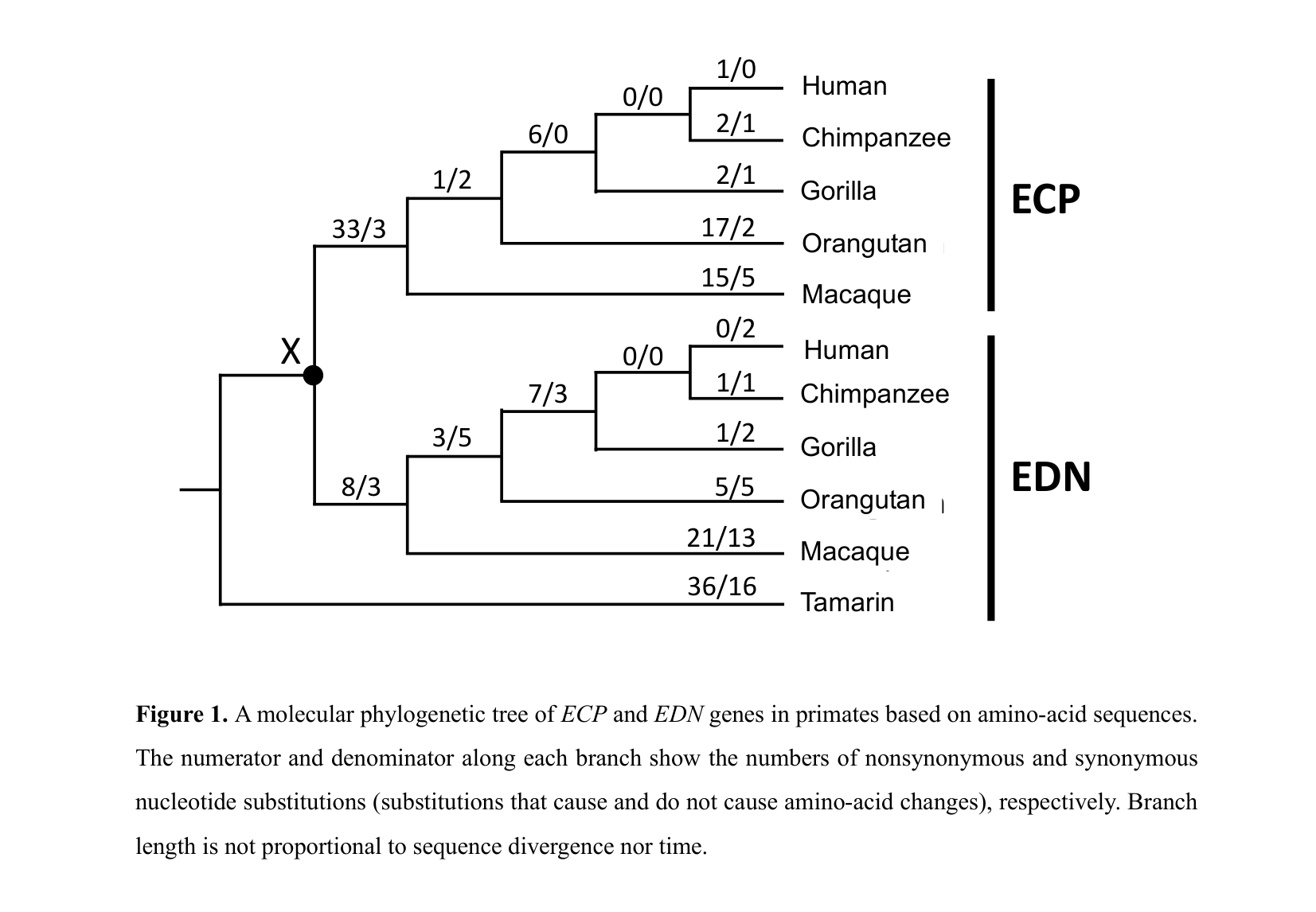 A molecular phylogenetic tree of ECP and EDN genes in primates based on amino-acid sequences. The numerator and denominator along each branch show the numbers of nonsynonymous and synonymous nucleotide substitutions (substitutions that cause and do not cause amino-acid changes), respectively.
Using the information and data, determine which of the statements are true or which are false.
Question reproduced from IBO 2020, Theoretical Exam 1, licensed under CC BY-NC-SA 4.0 - attributed to the International Biology Olympiad. Open the full exam PDF · Community solutions (unofficial)