Q38 - Parsimony Reconstruction of Opsin Gene Evolution in Human and Zebrafish
Following is the phylogenetic tree based on the amino-acid sequences of all opsin genes in the human and zebrafish genomes. Indicate whether each of the following statements is true or false under a parsimony principle.
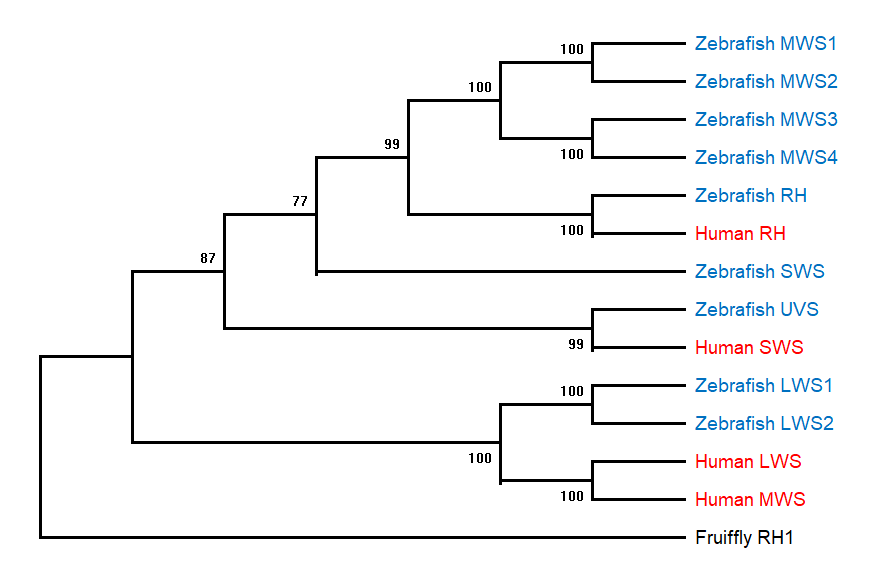 A phylogenetic tree based on the amino-acid sequences of all opsin genes in the human and zebrafish genomes. LWS: Long Wavelength Sensitive opsin, MWS: Middle Wavelength Sensitive opsin, SWS: Short Wavelength Sensitive opsin, UVS: Ultra Violet Sensitive opsin, RH: Rhodopsin type opsin.
Using the information and data, determine which of the statements are true or which are false.
Question reproduced from IBO 2020, Theoretical Exam 1, licensed under CC BY-NC-SA 4.0 - attributed to the International Biology Olympiad. Open the full exam PDF · Community solutions (unofficial)