Q39 - MC1R Alleles and Coat-Color Adaptation in Peromyscus polionotus
The Peromyscus polionotus inhabits the mainland of the Florida peninsula (Figure 1, locality 4) and has a dark-colored coat (Figure 1). In contrast, P. polionotus, inhabiting the light-colored sandy coastal dunes (Figure 1, localities 1-3), which are estimated to be 6,000 years old, has a lighter-colored coat (Figure 1). These mice show obvious differences in color patterns according to their habitat. The researchers compared the melanocortin 1 receptor gene (MC1R), a key gene for melanogenesis, and revealed the existence of two alleles, of which 65th amino acid residue is R or C, among these mice populations.
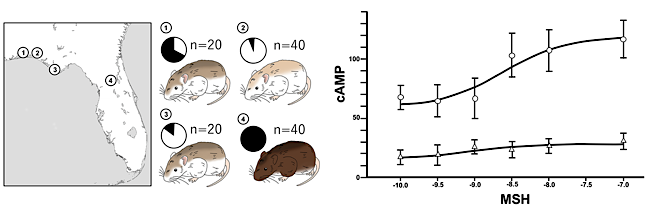 (left) Four localities of habitat of P. polionotus in the Florida peninsula. (right) Cartoons represent the color patterns of the mice in each locality. Pie charts indicate the frequencies of the R allele (black) and C allele (white). n indicates the number of individuals surveyed.
Using the information and data, determine which of the statements are true or which are false.
Question reproduced from IBO 2020, Theoretical Exam 1, licensed under CC BY-NC-SA 4.0 - attributed to the International Biology Olympiad. Open the full exam PDF · Community solutions (unofficial)