Q50 - Species Richness and Aboveground Biomass in Experimental Grassland Plots
Understanding how plant species richness affects community biomass production is important for biodiversity and ecosystem conservation. In a grassland, scientists created 72 experimental plots (1 m2 each) with different numbers of vascular plant species (from 1 to 10 species), with species combinations assembled randomly. Both local light and soil conditions were similar among the plots before establishing vegetation. After three years of this experiment, they harvested aboveground vegetation to measure aboveground biomass in each plot. The figure shows the relationship between species richness (number of species) and the dry weight of aboveground biomass (kg m-2) of plant communities in each plot. The line indicates the linear relationship obtained from the least square regression.
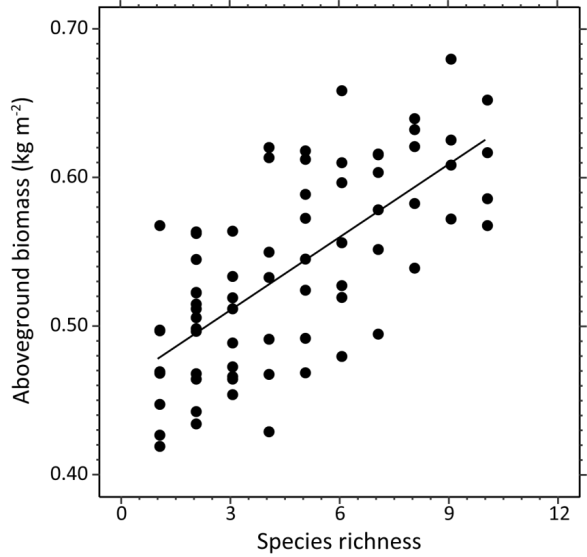 Figure 1.
Using the information and data, determine which of the statements are true or which are false.
Question reproduced from IBO 2020, Theoretical Exam 1, licensed under CC BY-NC-SA 4.0 - attributed to the International Biology Olympiad. Open the full exam PDF · Community solutions (unofficial)