Q22 - Planning a Two-Gene pBR322 Cloning Strategy with Compatible Restriction Sites
In the 1980s, a plasmid vector called pBR322 was frequently used for DNA recombination experiments. pBR322 is a 4361-base pair plasmid containing ampicillin resistance and tetracycline resistance genes, with the restriction enzyme sites shown in Figure 1. The experiment plans to ligate both gene P (from plasmid 1) and gene Q (from plasmid 2) into pBR322 using only restriction enzymes and DNA ligase (Figure 2), following six steps: (1) cleave plasmid 1 or 2 to get a fragment with gene P or Q, (2) cleave pBR322, (3) ligate the fragment into pBR322 (first recombinant plasmid), (4) cleave the other plasmid to get the second gene’s fragment, (5) cleave the first recombinant plasmid, (6) ligate the second fragment in. Recombinant E. coli cells are selected by ampicillin resistance, and having two replication origins in one plasmid must be avoided. Candidate operations: A: cut plasmid 1 with EcoRI+BamHI for gene P. B: cut plasmid 1 with EcoRI+ClaI for gene P. C: cut plasmid 2 with ClaI+BamHI for gene Q. D: cut plasmid 2 with ClaI+SalI for gene Q. E: cut plasmid 2 with ClaI+XhoI for gene Q. F: cut pBR322 with EcoRI+ClaI. G: cut pBR322 with EcoRI+BamHI. H: cut pBR322 with ClaI+BamHI. I: cut pBR322 with ClaI+SalI. X: ligate gene P fragment into cleaved pBR322. Y: ligate gene Q fragment into cleaved pBR322.
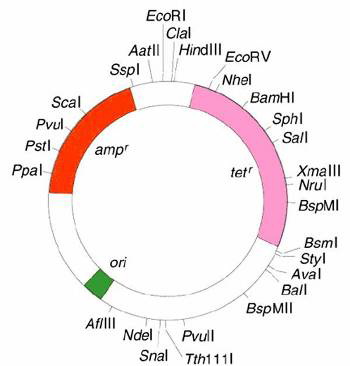 Figure 1.
Using the information and data, determine which of the statements are true or which are false.
Question reproduced from IBO 2020, Theoretical Exam 2, licensed under CC BY-NC-SA 4.0 - attributed to the International Biology Olympiad. Open the full exam PDF · Community solutions (unofficial)