Recombinant DNA & Biotechnology Techniques
Overview
This page covers the core nucleic-acid manipulation toolkit: how DNA fragments are cut, copied, cloned, detected, sequenced, and precisely edited. Together with Biomolecular Analytical Techniques (which covers the protein-focused counterparts, electrophoresis, chromatography), this is the direct answer to the most specific technique requests raised by BioGuide’s own student survey: named lab methods (blotting, PCR, sequencing) tested at the level of “what does this technique actually do and why would you choose it,” not just definitions.
Key Concepts
Restriction enzymes and cloning vectors
Restriction endonucleases recognise specific short palindromic DNA sequences and cleave the DNA there: bacterially derived defence enzymes (part of a bacterium’s own restriction-modification system against invading phage DNA) repurposed as precision cutting tools. Many restriction enzymes produce sticky ends (short single-stranded overhangs) rather than blunt ends; two DNA fragments cut by the same enzyme have complementary sticky ends and can be joined by DNA ligase, which is the physical basis of molecular cloning: a gene of interest, cut with a chosen restriction enzyme, can be ligated into a plasmid vector cut with the same enzyme, then introduced into a host bacterium (transformation) for propagation, amplification, or expression. Vectors typically carry a selectable marker (e.g. antibiotic resistance) allowing successfully transformed cells to be identified by growth under selective conditions.

PCR: exponential amplification without a living host
Polymerase chain reaction (PCR) amplifies a specific DNA sequence exponentially in a test tube, without requiring cloning into a living organism. Each cycle repeats three temperature-controlled steps: denaturation (~95°C, separating the double helix into single strands), annealing (~50–65°C, allowing short synthetic primers flanking the target sequence to bind their complementary single-stranded template), and extension (~72°C, a heat-stable DNA polymerase, most commonly Taq polymerase, originally isolated from the thermophilic bacterium Thermus aquaticus, whose heat tolerance is exactly what makes repeated 95°C denaturation cycles compatible with an active polymerase, extends each primer, synthesising new DNA). Because each cycle’s products become templates for the next cycle, the target sequence roughly doubles every cycle, producing exponential (2ⁿ) amplification from a vanishingly small starting sample: the property that makes PCR so useful for amplifying trace forensic, diagnostic, or ancient DNA samples.

Blotting techniques: three names, one shared logic, three different targets
All three blotting techniques share the same core workflow, separate biomolecules by gel electrophoresis, transfer them onto a solid membrane, then detect a specific target with a labelled probe, differing only in what is being detected:
- Southern blot (named after its inventor, Edwin Southern; the “Northern”/“Western” names are a deliberate pun extending the geographic joke) detects specific DNA sequences: DNA fragments are separated by agarose gel electrophoresis (see Biomolecular Analytical Techniques), transferred to a membrane, and probed with a labelled complementary DNA sequence that hybridises specifically to the target.
- Northern blot detects specific RNA sequences (typically mRNA), using the identical logic with an RNA sample and a complementary labelled probe, useful for directly assessing whether/how much a specific gene is being transcribed in a given sample.
- Western blot detects a specific protein: proteins are separated by SDS-PAGE (see Biomolecular Analytical Techniques) rather than agarose electrophoresis, transferred to a membrane, and probed with a labelled antibody specific to the target protein rather than a complementary nucleic acid probe: the detection chemistry is necessarily different (antibody-antigen recognition instead of nucleic acid hybridisation), since a protein has no complementary-sequence partner the way DNA/RNA do.
The naming and workflow parallel is deliberate and worth internalising as a set: same core logic (separate → transfer → probe), different molecule and different probe chemistry, a frequent source of confusion is forgetting that Western blot’s probe is an antibody, not a nucleic acid, because it’s the one technique in the set detecting a molecule without a complementary-sequence partner.

DNA sequencing: Sanger and next-generation approaches
Sanger (chain-termination) sequencing uses DNA polymerase, a primer, normal deoxynucleotides (dNTPs), and a small proportion of fluorescently labelled dideoxynucleotides (ddNTPs), which lack the 3′-OH group required for the next phosphodiester bond to form (see Nucleotide & Nucleic Acid Chemistry), so incorporation of a ddNTP terminates that strand’s extension at that exact position. Across many parallel synthesis reactions, this produces a population of fragments terminating at every possible position, each carrying a base-specific fluorescent label; separating these fragments by size (capillary electrophoresis) and reading the label at each length directly reveals the sequence, one base at a time, in order.
Next-generation sequencing (NGS) technologies (e.g. Illumina sequencing-by-synthesis) instead sequence millions of short DNA fragments in parallel, dramatically increasing throughput and lowering per-base cost relative to Sanger sequencing, at the cost of shorter individual read lengths that require computational reassembly (see the genome assembly methods covered in Bioinformatics) to reconstruct a full genome or long sequence. The core exam-relevant contrast: Sanger = one sequence at a time, longer accurate reads, still the gold standard for confirming/validating a specific short sequence; NGS = massively parallel, shorter reads, dramatically higher throughput, suited to whole-genome-scale sequencing.
CRISPR-Cas9: precise, programmable genome editing
CRISPR-Cas9 repurposes a bacterial adaptive immune system (which normally recognises and cleaves invading phage DNA using stored sequence memory) into a programmable genome-editing tool. A synthetic guide RNA (gRNA), designed to be complementary to the genomic target sequence, directs the Cas9 nuclease to that specific site via RNA-DNA base pairing, where Cas9 creates a targeted double-strand break. The cell’s own DNA repair machinery then resolves the break: via NHEJ (error-prone, often producing small insertions/deletions that disrupt the target gene, useful for gene knockout) or, if a repair template is supplied alongside, via homologous recombination (precise, allowing a specific designed sequence change to be introduced, see DNA Repair & Recombination for both repair pathways in full). CRISPR’s defining advantage over older genome-editing methods is that target specificity is programmed simply by changing the guide RNA’s sequence, no need to engineer a new protein for each new target, unlike earlier programmable nucleases (zinc-finger nucleases, TALENs), which required labour-intensive custom protein engineering for every new target site.

Comparative Structures
| Blot type | Target molecule | Separation method | Probe type |
|---|---|---|---|
| Southern | DNA | Agarose gel electrophoresis | Complementary labelled DNA |
| Northern | RNA | Agarose gel electrophoresis (denaturing) | Complementary labelled RNA/DNA |
| Western | Protein | SDS-PAGE | Labelled antibody |
| Sequencing method | Throughput | Read length | Typical use |
|---|---|---|---|
| Sanger | Low (one sequence per reaction) | Long, high per-base accuracy | Validating/confirming a specific known-region sequence |
| Next-generation (NGS) | Very high (massively parallel) | Short, requires computational assembly | Whole-genome/transcriptome-scale sequencing |
Common Exam Questions
- “Which blotting technique would you use to detect [DNA/RNA/protein]?”: direct application of the Southern/Northern/Western-to-target mapping; a frequent trick is asking about detecting whether a gene is being transcribed (Northern, RNA) versus whether a specific allele/DNA sequence is present (Southern, DNA), easily confused if the molecule-type distinction isn’t kept explicit.
- “Why does Taq polymerase specifically enable PCR, when standard DNA polymerases do not?”: the correct answer must cite heat stability surviving repeated 95°C denaturation cycles, not simply “it’s a DNA polymerase.”
- “Why do ddNTPs terminate Sanger sequencing reactions specifically?”, the missing 3′-OH group, required for the next phosphodiester bond, is the precise chemical mechanism expected in a complete answer.
- “What gives CRISPR-Cas9 its main practical advantage over zinc-finger nucleases/TALENs?”: reprogrammability via simple guide RNA sequence change, rather than requiring new protein engineering per target, is the expected specific answer.
Visual Reference
Interactive
- A PCR cycle simulator: step through denaturation/annealing/extension across several cycles with a copy-number counter doubling each round, visually demonstrating exponential amplification from a single starting template.
Static
(Static images are placed inline in Key Concepts above, next to the concept each one illustrates, rather than collected here.)
Practice Challenge
Competition-sourced practice questions for this topic, graded by difficulty. Click the Solution tab to reveal each answer.
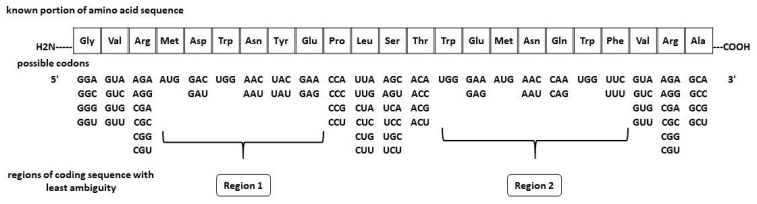
A molecular biologist was trying to make synthetic nucleic acid probes against the transcript of the given peptide. Although only one nucleotide sequence will actually code for the protein, the degeneracy of the genetic code could result in several different nucleotide sequences that will give the same amino acid sequence, and it is impossible to tell in advance which is the correct one. Because it is desirable to have as large a fraction of the correct nucleotide sequence as possible in the mixture of oligonucleotides to be used as a probe, those regions with the fewest possibilities are chosen, as shown by regions 1 and 2.
If probes have to be designed separately for each region, how many total possible oligonucleotide probes would have to be synthesized?
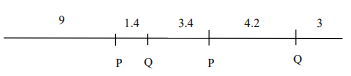
In a restriction digestion experiment, a sample of a synthetic linear DNA molecule 21 kbp in length was treated with an enzyme ‘P. Another sample of the same DNA was treated with another restriction enzyme ‘Q’. The fragments (in kbp) obtained after gel electrophoresis profiling are as follows: Reaction 1: Treatment with enzyme P: 9, 7.2 and 4.8 Reaction 2: Treatment with enzyme Q: 10.4, 7.6 and 3
The fragment mixture obtained in reaction 1 was then treated with enzyme Q. Similarly, the fragment mixture obtained in reaction 2 was treated with enzyme P. The fragments (in kbp) obtained from these treatments are given below. Reaction 3: Reaction mixture from reaction 1 treated with enzyme Q: 9, 4.2, 3.4, 3, 1.4 Reaction 4: Reaction mixture from reaction 2 treated with enzyme P: 9, 1.4, 4.2, 3.4, 3
Based on the fragments obtained, draw the restriction map indicating the positions of the restriction sites of the enzymes P and Q. Also, indicate the fragment lengths between the sites
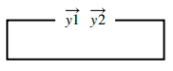
Golden gate assembly is a one-step cloning method for joining multiple DNA inserts into a plasmid backbone. This method uses Bsal (a type IIs restriction enzyme). In contrast to traditional restriction enzymes, it recognizes a non-palindromic sequence and cuts the adjacent sequence, which is shifted by a number of base pairs, as shown in the figure below.
Notice the restriction enzymes are only specific for the recognition site (shaded in gray), while the cutting site can have any nucleotide sequence. Consider combining the following plasmid backbone:
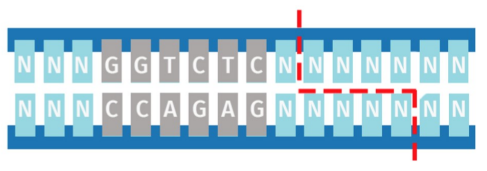
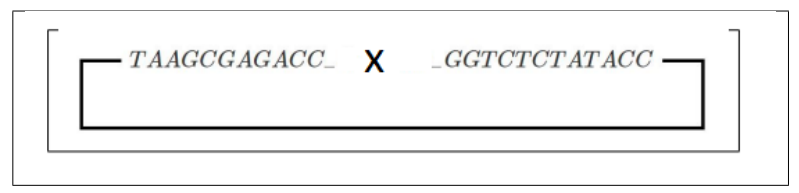
And the two following inserts:
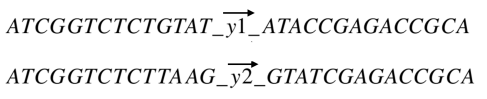
For each of the constructs below, indicate if it can be observed after treatment with BsaI and DNA ligase.
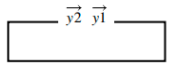
A B
C D
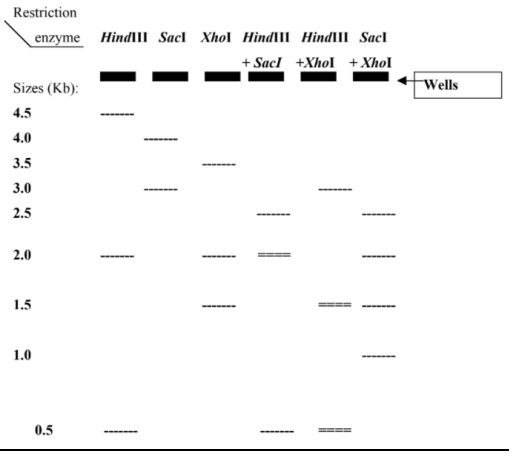
YAC DNA (with its telomeres) is cleaved with HindIII, SacI, XhoI, or a combination of HindIII and SacI, HindIII and XhoI, or SacI and XhoI. After restriction digestion, the products of each reaction are loaded in separate wells of an agarose gel and separated by agarose-gel electrophoresis. The following fluorescence patterns are observed on the gel (Double line indicates that 2 fragments of similar size are generated by the digestion).
Provide a restriction map for this YAC clone, and indicate on this map the distance between successive restriction sites.

Practice Problems
1. A researcher wants to determine whether a specific gene is being actively transcribed in a tissue sample, and separately wants to confirm the exact DNA sequence of that gene’s promoter region in the same organism. Which two techniques from this page would address each question respectively, and why would the other technique not answer the first question?
Show answer
Northern blot addresses whether the gene is being actively transcribed: it detects and quantifies the specific mRNA transcript directly, which is present only if transcription is actually occurring. Sanger sequencing (or NGS) confirms the exact DNA sequence of the promoter region: it reads out nucleotide sequence directly, regardless of whether that region is currently being transcribed. A Southern blot would not answer the transcription question, since it detects DNA (which is present in the genome whether or not the gene is being transcribed) rather than RNA, Southern blot confirms a sequence/allele is present, not that it is currently active.
2. Explain why PCR would fail (or produce far lower yield) if a non-heat-stable DNA polymerase were used instead of Taq polymerase, referencing the specific step of the PCR cycle where the problem would occur.
3. A CRISPR-Cas9 experiment is performed with a guide RNA and Cas9, but no repair template is supplied alongside. Predict the most likely outcome at the target site, and explain which DNA repair pathway is responsible.