Most mammalian bones are formed through a process called “endochondral ossification,” in which the cartilage
first forms the template of skeletal elements and then is mostly replaced by mineralized bone. Figure 1 shows a
schematic drawing of endochondral ossification of the long bone of mice (wild type), and the long bone of mice
with gain or loss of function in gene A or gene B. Both gene A and gene B are involved in skeletal development.
In the wild type, the day-14 embryo bone is nearly all cartilage, the newborn bone is part cartilage/part
mineralized bone, and the adult bone is nearly all mineralized bone. A gene A loss-of-function newborn mutant
forms no cartilage and no bone at all. Gene A and gene B gain- and loss-of-function newborn mutants otherwise
show varying amounts of cartilage versus mineralized bone as illustrated.
Figure 1.
Using the information and data, determine which of the statements are true or which are false.
interpretation of gene A and gene B. Choose the correct interpretation of endochondral ossification and the function of genes A and B.
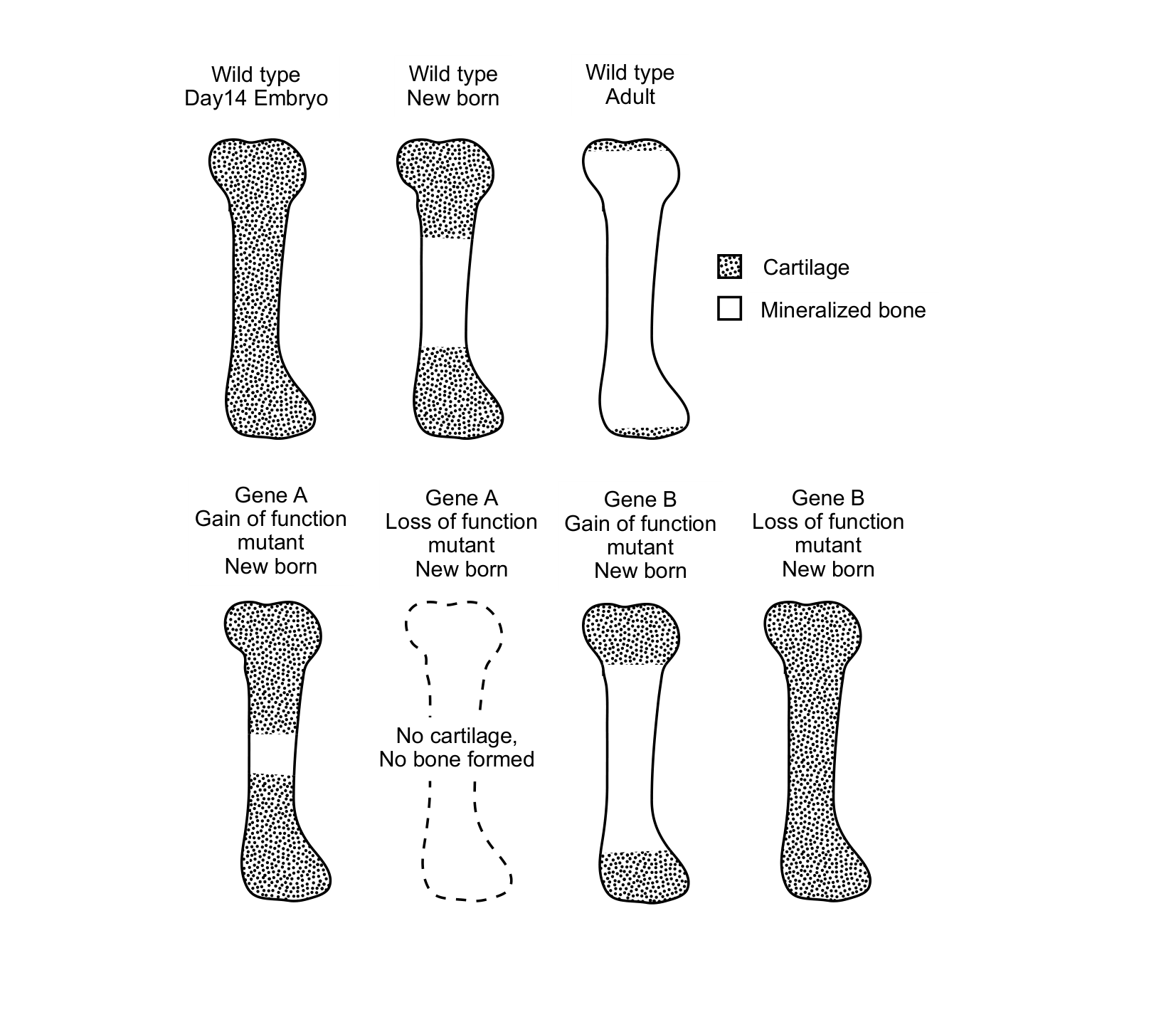 Figure 1.