Q27 - Testing How Honeybees Measure Flight Distance for the Waggle Dance
The honeybee (Apis mellifera) communicates the distance of a food source to others by dancing. The bee performs “round dances” when the feeder is within 50 m. If the feeder is over 50 m, they perform “waggle dances.” The mean durations (ms) of waggle dances are plotted in Figure 1 against distance (m). To determine how bees measure this distance, two types of wooden tunnels with a food source were positioned outdoors (Figure 2). The tunnel is 6 m long. The walls and floor were randomly patterned (black-and-white, 1 cm pixels) in experiments 1, 2, and 4, and axially striped in experiment 3. In experiments 2 and 4, the mean waggle durations were 529 ms and 441 ms, respectively (experiment 2’s feeder was farther inside the tunnel, at the far/closed end, 35 m outside-equivalent; experiment 4’s feeder was near the tunnel entrance, 6 m outside-equivalent, both continuing outside the tunnel to reach the total distance).
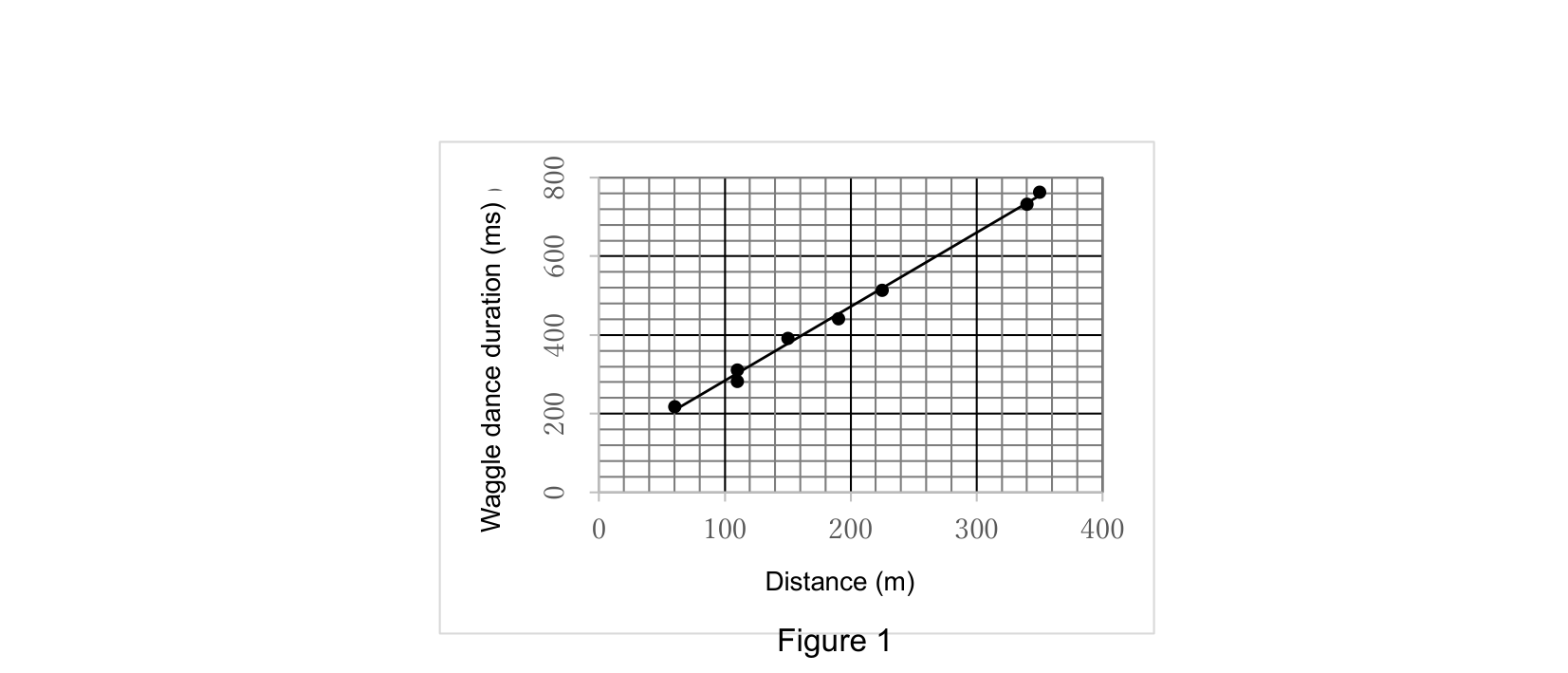 Figure 1.
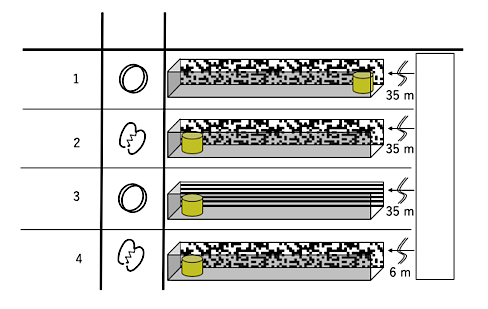 Figure 2.
Using the information and data, determine which of the statements are true or which are false.
Question reproduced from IBO 2020, Theoretical Exam 2, licensed under CC BY-NC-SA 4.0 - attributed to the International Biology Olympiad. Open the full exam PDF · Community solutions (unofficial)