Early splendor, a cultivar of ornamental amaranth (Amaranthus tricolor), begins to form red leaves in late
summer to early autumn, after producing fully green leaves. The first few red leaves are only partially red, each
consisting of distal green and proximal red regions. Finally, fully red leaves form after the formation of
partially red leaves. The color pattern of each leaf remains unchanged after leaf emergence. The timing of red
leaf formation is considerably influenced by photoperiodic conditions. Plants were cultured in 16L8D, 14L10D,
12L12D, 8L16D, or 7L8D1L8D conditions, and “plants with red leaf” (%) and “total leaf number” were tracked
over time.
Figure 1.
Using the information and data, determine which of the statements are true or which are false.
Q30-1. Rank the 70-day-old plants cultured under the five different photoperiodic conditions (1: 16L8D, 2: 14L10D, 3: 12L12D, 4: 8L16D, 5: 7L8D1L8D) in descending order of their average number of red leaves.
12L12D > 8L16D > 7L8D1L8D > 14L10D > 16L8D: The number of red leaves on a 70-day-old plant equals its total leaf number at day 70 minus the leaf position at which red leaves first began forming, plus one. Working this out from the growth curves: 12L12D forms about 18-10+1 = 9 red leaves, 8L16D about 10-4.5+1 = 6.5, 7L8D1L8D about 10-6+1 = 5, 14L10D about 21.5-19+1 = 3.5, and 16L8D forms no red leaves at all (0) since it never induces red leaf formation: giving the descending order 12L12D > 8L16D > 7L8D1L8D > 14L10D > 16L8D.
Q30-2. Assuming a red leaf-inducing signal X is produced in expanded leaves and transported to the shoot apical region, two hypotheses explain the partially-red color pattern: I, the distal part of each leaf primordium requires a higher concentration of signal X for red coloration than the proximal part; II, during leaf primordium development, the distal part is determined for coloration earlier than the proximal part. Which experiment is most informative to distinguish between these hypotheses?
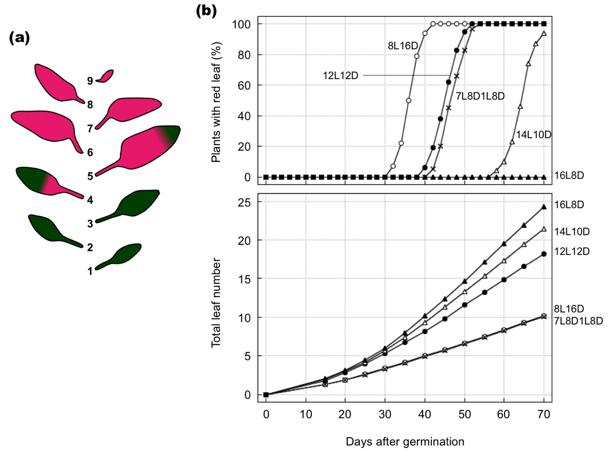 Figure 1.