Q25 - Oxytocin and Cortisol - Touch vs. Voice Contact in Girls
Oxytocin is a neuropeptide that plays a crucial role in shaping social relations and interactions, thought to be produced in response to tactile contact. Scientists studied oxytocin release in girls aged 7–12 after a public-speaking contest (stressor). The control group immediately watched a neutral movie; the tactile group had 15 minutes of direct contact with their mothers first; the vocal group instead spoke with their mothers by phone for 15 minutes. Cortisol and oxytocin levels were measured throughout.
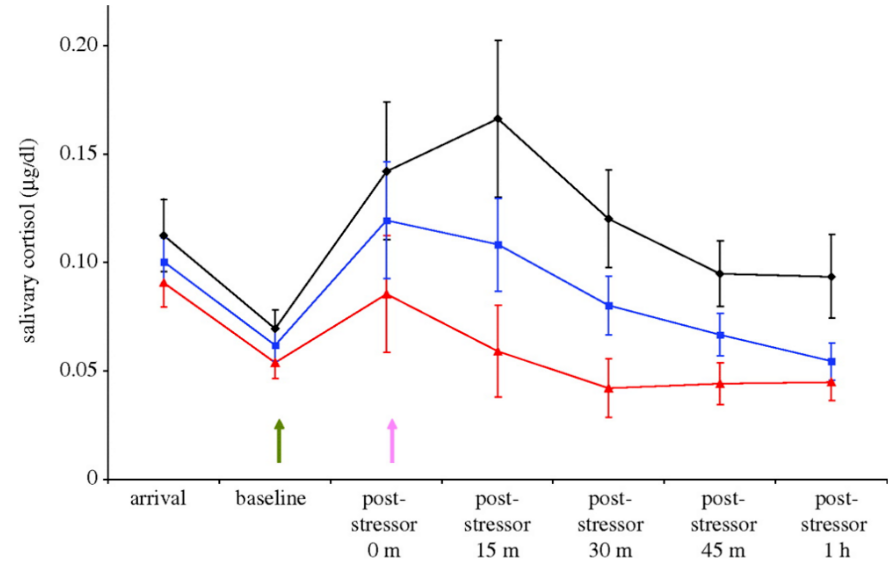 Figure 1. Changes in cortisol levels during observations. Green arrow: start of public speaking. Pink arrow: end of public speaking. Black - control, Blue - vocal, Red - tactile. Cortisol rose from baseline to peak in all groups; the no-contact (control) group had higher cortisol even an hour after the stressor than the other two groups.
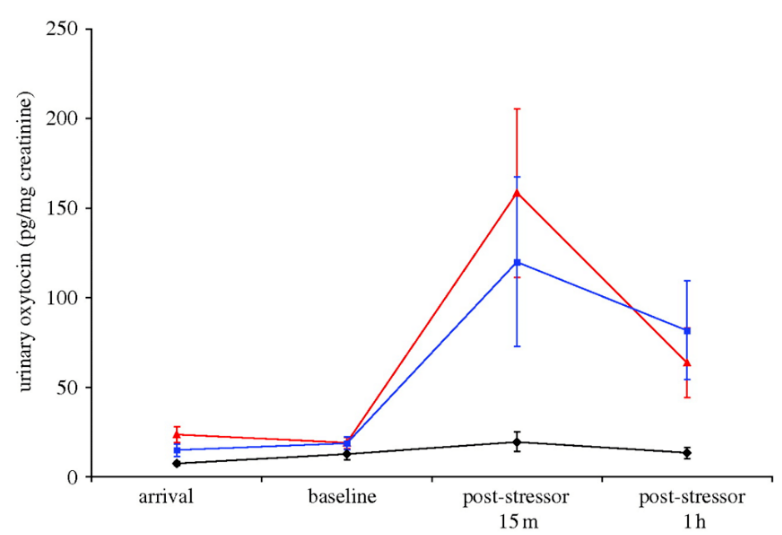 Figure 2. Oxytocin content in urine, relative to creatinine. Black - control, Blue - vocal, Red - tactile. Both physical and speech-only contact raised oxytocin within 15 minutes post-stressor, an effect maintained up to 1 hour post-stressor.
Using the information and figures, determine whether the following statements are true or false:
Question reproduced from IBO 2022, Theoretical Paper 1, licensed under CC BY-NC-SA 4.0 - attributed to the International Biology Olympiad. Open the full exam PDF · Community solutions (unofficial)