Q24 - Comparative Liver Anatomy - Zebrafish vs. Human
During the evolution of vertebrates, changes in the structure of organs and organ systems have occurred.
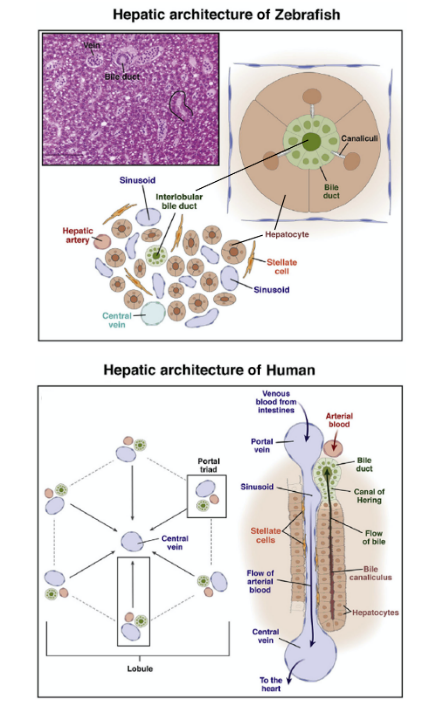 Hepatic architecture of zebrafish (left) vs. human (right), showing bile ducts, sinusoids, hepatic artery/vein, central vein, portal triad, hepatocytes, and stellate cells.
Based on the figure, determine whether the following statements are true or false.
A. Like the human liver, zebrafish liver is also characterized by a lobular structure where the bile duct is located in the center of each lobule rather than a central vein as in the human liver.
B. In contrast to human liver, the blood vessels of zebrafish liver are distributed irregularly in the organ.
C. All types of cells in the liver of the zebrafish are also present in the human liver.
D. The hepatocytes of the hexagonal lobules of the human liver differ in oxygen content, with the pericentral cells having a higher oxygen concentration than the periportal cells.
Question reproduced from IBO 2022, Theoretical Paper 1, licensed under CC BY-NC-SA 4.0 - attributed to the International Biology Olympiad. Open the full exam PDF · Community solutions (unofficial)