Q39 - Mutation Rates - Asexual vs. Sexual Yeast Populations
To understand the molecular mechanisms behind the origins of adaptation during asexual and sexual reproduction, scientists studied mutations in asexually and sexually replicating populations of the yeast Saccharomyces cerevisiae (100,000 individuals, ~1000 generations). Mutations were classified as intergenic, synonymous, or non-synonymous, and tracked as either “All” (all mutations arising during the experiment) or “Fixed” (mutations present in all individuals by the end).
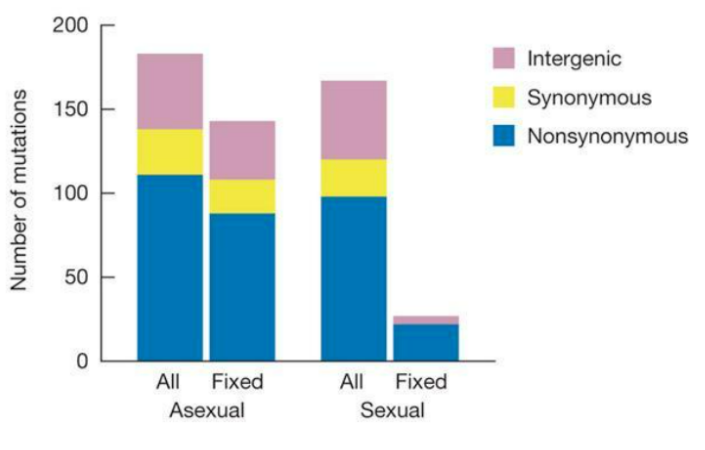 Mutations in asexual and sexual populations of the yeast Saccharomyces cerevisiae, broken down by mutation type (intergenic/synonymous/nonsynonymous) and by All vs. Fixed.
Using the information and analysis, determine whether the following statements are true or false:
Question reproduced from IBO 2022, Theoretical Paper 1, licensed under CC BY-NC-SA 4.0 - attributed to the International Biology Olympiad. Open the full exam PDF · Community solutions (unofficial)