Q47 - Codling Moth - Temperature/Humidity Ecological Niche
Codling moth (Cydia pomonella) is a serious agricultural pest; favorable environmental conditions can cause population outbreaks. In an experiment, researchers studied the minimum and maximum survival of codling moth pupae under different temperature/humidity conditions. Table 1: combinations causing 100% pupal mortality. Table 2: combinations with the lowest mortality (under 10%).
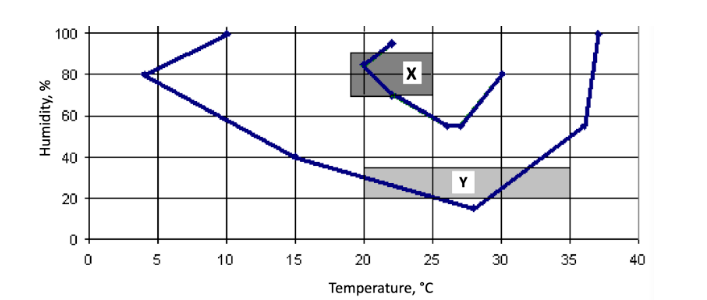 Figure 1. Diagram of the coordinate space of the two-dimensional ecological niches of codling moth. The jagged curve traces 100%-mortality combinations (Table 1); zones X and Y mark two regions of interest.
Using the information and data, determine whether the following statements are true or false:
Question reproduced from IBO 2022, Theoretical Paper 1, licensed under CC BY-NC-SA 4.0 - attributed to the International Biology Olympiad. Open the full exam PDF · Community solutions (unofficial)