Q46 - Three-Toed Sloth Fur Ecosystem - Moths, Algae, and Fungi
Three-toed sloths (Bradypus sp.), found in South and Central America, spend their entire lives in tree foliage, descending only once a week to defecate. Cryptoses choloepi moths live in sloth fur, defending them from insectivorous birds, and moving with sloths to lay eggs in their feces (larvae feed on the feces; adult moths climb back onto sloths). Algae of the genus Trichophyllus also grow in sloth fur, serving as food for the sloth and turning its fur greenish for camouflage. Ascomycota fungi decompose dead moth bodies in the fur, producing nutrition for the algae.
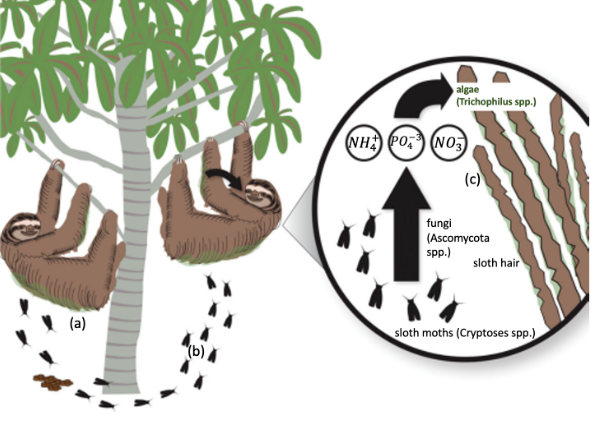 Figure 1. Relationships between the three-toed sloth and the organisms living in its fur: algae (Trichophilus spp.), fungi (Ascomycota spp.), and moths (Cryptoses spp.).
Using this information, determine whether the following statements are true or false:
Question reproduced from IBO 2022, Theoretical Paper 1, licensed under CC BY-NC-SA 4.0 - attributed to the International Biology Olympiad. Open the full exam PDF · Community solutions (unofficial)