Q90 - Cannibalism and Larval-Stage Duration in Invasive Cane Toads
The South American (French Guiana) cane toad (Rhinella marina) was introduced to Australia about 90 years ago to control the cane beetle (Dermolepida albohirtum) populations. To study the adaptive features of the species under the new conditions, the phenomena of cannibalism and the duration of the early larval stage (non-feeding) were studied.
In the first experiment, the late-stage tadpoles of native South American and invasive Australian populations were released into two separate aquariums, each divided by a maze. One part of each aquarium contained clean water and the other part had newly hatched larvae of the same source population (Figures A, B). In the second experiment, tadpoles and larvae of the respective populations were placed together in two separate aquaria and the proportion of cannibalism was recorded for each population (Figure C). In the third experiment, to study the duration of the early larval stage (non-feeding), the larvae of each population were divided into two groups. One was kept in clean water and the other in an aquarium containing late-stage tadpoles of the same population (Figure D).
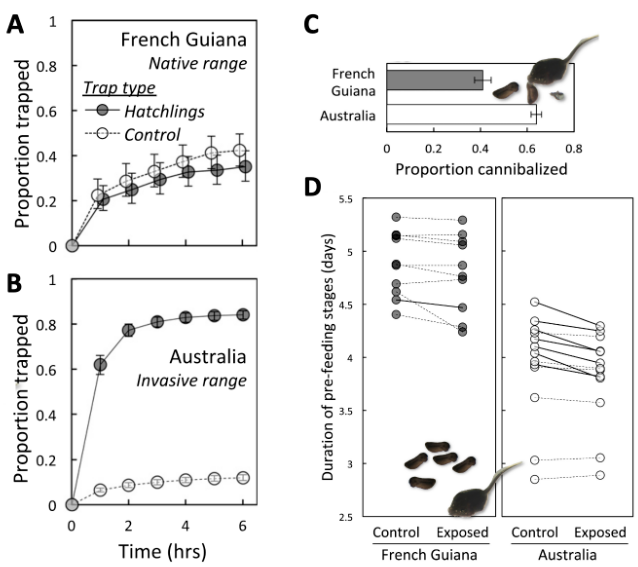 Figure: A, B - Graphs of movement of tadpoles in the aquarium (A – South American, B – Australian). Horizontal axis – time, vertical axis – the proportion of tadpoles. White circles – tadpoles swimming towards clean water, black circles – tadpoles swimming towards larvae. C - the proportion of larvae cannibalized; D - duration of the pre-feeding stages determined in separate aquariums, one with clean water (control), the other with late-stage larvae (experimental). Solid lines: p < 0.05.
Using the information and the figures above, determine which of the statements are true or which are false.
Question reproduced from IBO 2022, Theoretical Paper 2, licensed under CC BY-NC-SA 4.0 - attributed to the International Biology Olympiad. Open the full exam PDF · Community solutions (unofficial)