Q100 - Cold-Exposure Duration, Acclimation and Mollusc Survival
One of the modern environmental problems is the spread of invasive alien species, the success of which is due to the adaptive properties of these species. Temperature is one of the most important environmental factors for species. The experiment examined the cold resistance of the Melanoides granifera mollusc, a representative of the tropical fauna, to low temperatures. The molluscs were initially kept at low temperatures for 8 hours or 168 hours, then transferred to 18°C or 20°C conditions for acclimation (Figure 1). The lowest temperature threshold for survival was investigated.
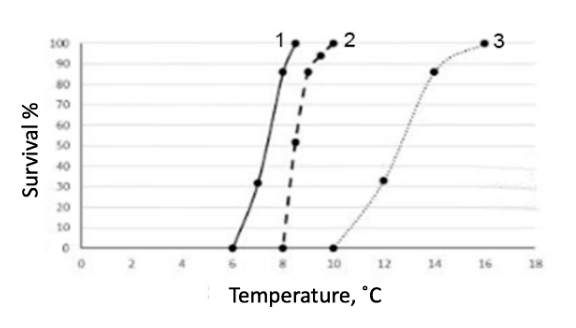 Figure 1. The survival of molluscs Melanoides granifera after acclimation, as a function of the temperature of cold exposure. Curve 1: survival after 8 hours cold exposure and acclimation at 18°C. Curve 2: survival after 8 hours cold exposure and acclimation at 20°C. Curve 3: survival after 168 hours cold exposure and acclimation at 20°C.
Using the information and the figure, indicate whether the following statements are true or false.
Question reproduced from IBO 2022, Theoretical Paper 2, licensed under CC BY-NC-SA 4.0 - attributed to the International Biology Olympiad. Open the full exam PDF · Community solutions (unofficial)