Q17 - Community Similarity: Sorensen-Dice and Jaccard
In ecology, the similarity of two communities can be measured by calculating the Sorensen-Dice coefficient (DSC) and Jaccard index (JI).
DSC = 2C / (A + B)
JI = C / (A + B - C)
Where A and B are the number of species in the two communities and C is the number of species common to both communities.
In the figure below, you can see two samples of invertebrates, collected from two small rivers, i and ii respectively. Similar looking animals belong to the same species. Calculate the Sorensen-Dice coefficient and Jaccard index for the rivers i and ii.
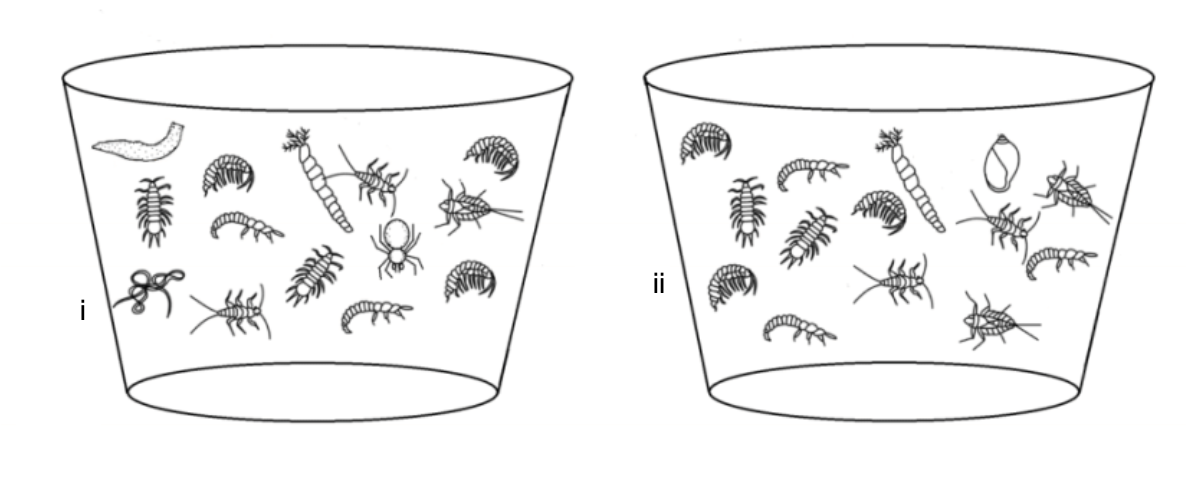 Samples of invertebrates from rivers i and ii. Similar looking animals belong to the same species.
Question reproduced from IBO 2023, Theoretical Paper 1, licensed under CC BY-NC-SA 4.0 - attributed to the International Biology Olympiad. Open the full exam PDF