Q28 - Xylem Embolism and Hydraulic Safety Margins
“Embolism” in xylem vessels means the presence of air-filled tracheids and/or vessels. Embolisms can result in a substantial impairment of xylem transport and thus hydraulic failure.
Environmental causes of embolism include water stress and winter freezing; potential consequences include reduction of growth and dieback.
Choat et al. (2012) examined the vulnerability of forests to drought-induced hydraulic failure. They measured the minimum xylem pressure in plants under natural conditions (Psi_min), and the xylem pressure (P50) at which 50% loss of conductivity occurs. They included both angiosperms and gymnosperms in different climate conditions: mean annual precipitation (MAP) ranged from 300 to 4,500 mm, and mean annual temperature from -4°C to 27°C (Figure a).
The difference between Psi_min and PX (at which X% loss of conductivity occurs) represents a “safety margin” within which the plant operates in a given environment (Figure b).
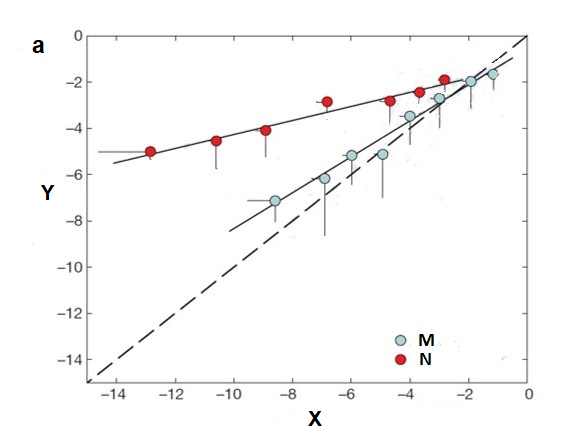 Figure a. Minimum xylem pressure (Psi_min) plotted against P50 for angiosperm (M, blue) and gymnosperm (N, red) species. Dashed line = 1:1 (zero safety margin).
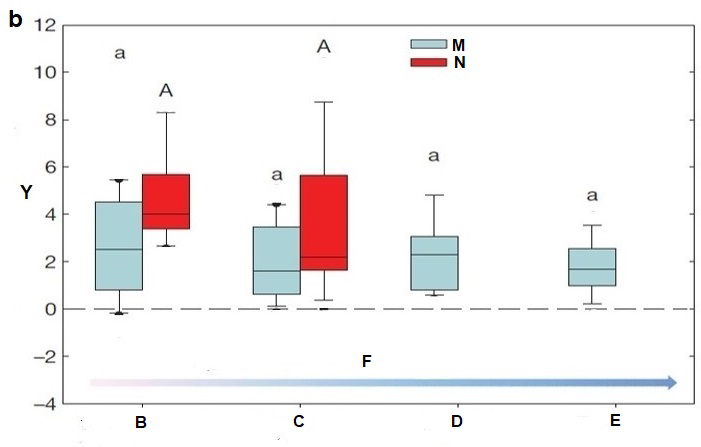 Figure b. Hydraulic safety margins across forest biomes. M = Angiosperms (blue), N = Gymnosperms (red). B = Mediterranean/Woodland, C = Temperate forest, D = Tropical seasonal forest, E = Tropical rain forest. F = increasing MAP.
Question reproduced from IBO 2023, Theoretical Paper 1, licensed under CC BY-NC-SA 4.0 - attributed to the International Biology Olympiad. Open the full exam PDF