Q5 - Desert March Dehydration and SIADH
Part A
In an experiment, soldiers were ordered to march through a hot desert until exhaustion (they were then retrieved and given a reward).
- One group (red) had no food or water.
- The second (blue) group had access to limitless water.
- The third group (black) had access to both limitless water and limitless savoury (salty, low energy) food.
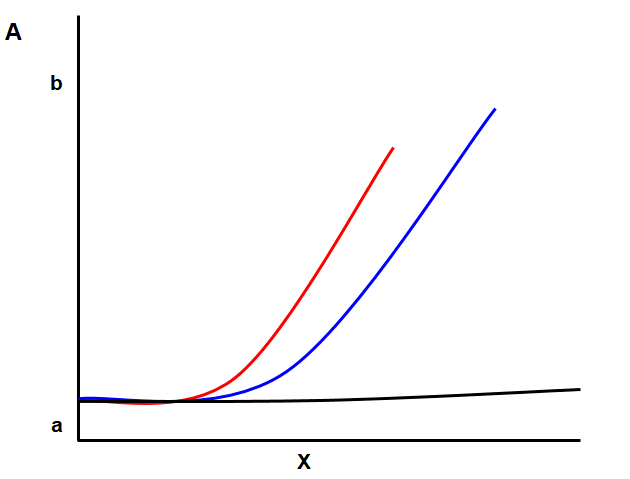 A: Core body temperature. X = Length of march. a = Normal, b = Hot.
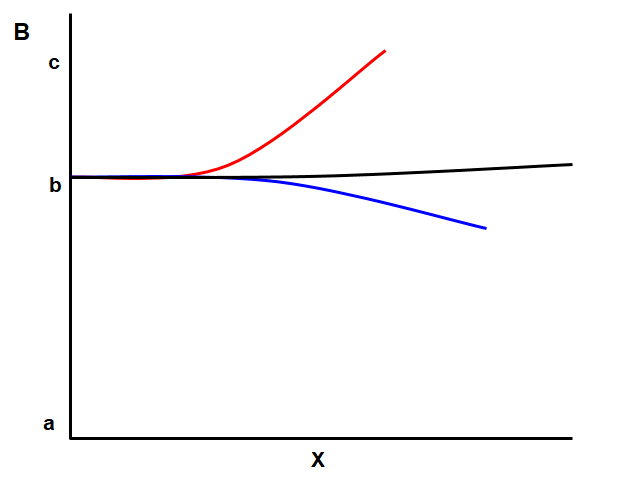 B: Blood osmolarity. X = Length of march. a = Low, b = Medium, c = High.
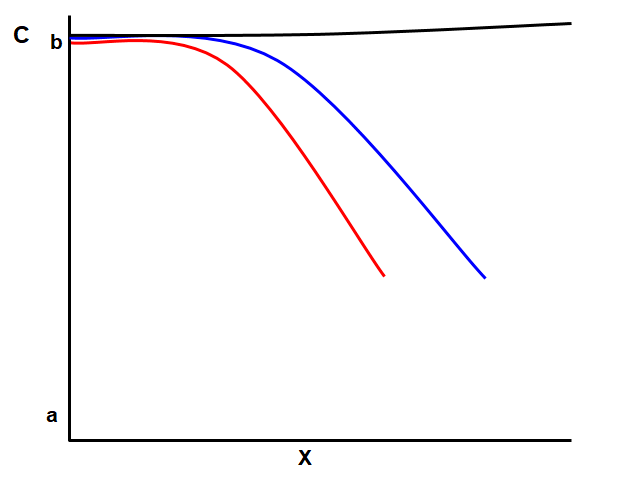 C: Cardiac output. X = Length of march. a = Low, b = Normal.
Starling’s law of the heart shows that cardiac output is always proportional to mean systemic filling pressure (the pressure of blood in the great veins). This is because the heart cannot suck blood through vessels (they collapse), it can only pressurise the blood which the great veins deliver to it.
Camels are adapted to withstand larger swings in osmolarity and core temperature than other mammals. Camels and humans both have the very rare ability to sweat. Sweat is mostly water, with a small amount of salt. (Note: camel humps are almost entirely fat, located to reduce surface area exposed to midday sun, similar to humans’ unusually upright posture).
Part B
Antidiuretic hormone (ADH, also known as vasopressin) is usually released from the pituitary gland in proportion to blood osmolarity. ADH acts on very-high affinity receptors in the kidney to increase urine concentration. ADH also acts on low-affinity receptors across blood vessels, increasing their tone (squeezing on blood). Some patients have tumours which secrete ADH (syndromes of inappropriate ADH secretion).
Determine whether the following statements are true or false:
Question reproduced from IBO 2023, Theoretical Paper 1, licensed under CC BY-NC-SA 4.0 - attributed to the International Biology Olympiad. Open the full exam PDF