Q14 - Submarine Atmosphere and Oxygen
Lung surface area and the speed of oxygen delivery to blood are very rarely the limiting factors for oxygen delivery in a healthy person. Blood usually flows slowly enough that alveolar air is in equilibrium with blood. Instead, the oxygen affinity of hemoglobin is the main determinant of oxygen loading.
Binding affinity describes the change in binding with concentration. For gases, the molarity of solutions is directly proportional to their partial pressure in air. Partial pressure is the pressure exerted by a particular gas in a mixture of gases.
However, the rate of fire burning is limited by crowding by non-flammable molecules and the strength of convection currents.
The curves below plot the height of a candle flame against the % oxygen in the air (the proportion of total molecules which are oxygen) when the partial pressure of oxygen is fixed.
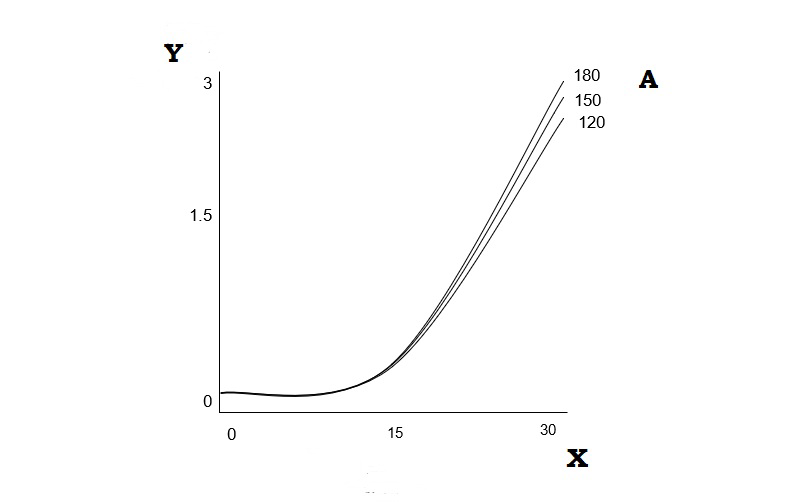
Modern military submarine air processing units produce an atmosphere of 16% oxygen at 130% normal sea-level pressure.
True or False?
Question reproduced from IBO 2023, Theoretical Paper 2, licensed under CC BY-NC-SA 4.0 - attributed to the International Biology Olympiad. Open the full exam PDF